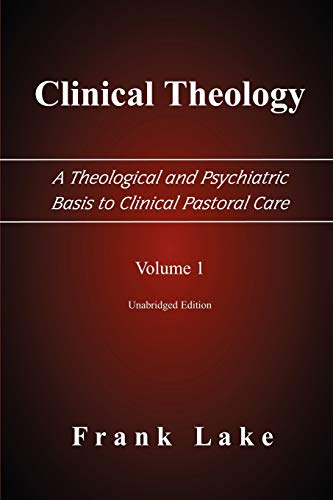
Clinical Theology was first published in 1966. It was written by Dr F. Lake who spent several years as a missionary doctor in India. He then returned to England and specialized in psychiatry. He began to train doctors, clergy and lay people in the psychiatric side of pastoral care. Psychodynamically Lake is in the British School of Objects Relations Theory. Theologically he grew up in the evangelical part of the Church of England.
The size of the original work, along with its complex language, made it a far from easy book to read. Martin Yeomans is a Methodist minister and was from 1977–1982 a full-time Pastoral Consultant with the Clinical Theological Association. He has attempted in this abridged version to open up the book to a wider audience.
Clinical theology as a system of pastoral care has been widely acclaimed by a large number of people, many of whom say that it has revolutionized their ministries.
The book begins by looking at the Christian service of listening, in particular focusing on the great resource we have in the gospel. It goes on to look at a model of theology and psychodynamics. It deals with certain personality types—the depressed, hysterical, schizoid and paranoid, finally finishing up by looking at anxiety and related defensive reactions. The questions could be asked, where are the ‘normal’ problems that confront the minister or lay-person?
Lake felt that Otto Rank’s insistence on the primacy of birth trauma in the production of anxiety began to make sense. He was convinced that any successful therapy needed to rediscover the patient’s primal roots. Personality and psychosomatic stress are seen as ongoing from the first three months of pregnancy. The emotional state of the mother communicates itself to the foetus—so if the mother has negative feelings they transfuse to the foetus and hysterical-schizoid reactions may arise.
In order to help a person you need primal integration, that is, an alliance must be formed with the adult mature part of the person so he can recognize and accept the child part of the past and the foetus in the womb and bring together what the primal pain has split. Christ is central in this process, the source of a new being. The main clinical pastoral task is to deal with the evils we have suffered rather than those we commit. It is important in counselling to deal with the problems of being sinned against, but it is essential, if one is to deal with the whole person, to look at the sins committed by that person, which this book does not appear to do.
This book offers some valuable insights. It is particularly good on dealing with the counsellor himself, and the problems he needs to overcome—an area which many counselling books either overlook or treat superficially. The practice arising from clinical theology introduces the reader to a variety of methods. Appendix A is very useful on outlining the behaviour of the hysterical and schizoid personalities. Appendix B, which outlines the pastoral recording of a case, is excellent—a clear guide of the areas which a counsellor should investigate. The focus on Christ as the answer to our problems is absolutely vital. The innocent suffering is taken up in the afflictions of a crucified Christ. Lake aims to promote understanding between the disciplines of psychology and theology.
At times it tries too hard to make the connection between the two disciplines and makes somewhat tenuous links. Lake has been accused of ‘baptizing the therapies’ in his eclectic approach. The overall impression gained of clinical theology is that it looks at psychology, psychiatry and different experiences and then brings Scripture to them. Whilst at times this may work, all too often one can fall into the trap of interpreting Scripture in the light of experience rather than the other way round, which as evangelical Christians is the only way we can approach Scripture. The chapter on schizoid personalities looks at how Jesus deals with the paradoxes of those with hystero-schizoid problems. The illustration used is the Syro-phoenician woman in Mt. 15. After careful reading of that passage it is hard to see how with such scanty information one can diagnose the woman as a hystero-schizoid personality. There are other examples which make similar, seemingly unfounded, assumptions.
The language used is at times very technical and difficult to understand, especially if the reader has no background in psychology (the glossary does help a little). One almost feels that there needs to be an introductory book to this book! It goes into some quite complex psychological concepts but yet deals with them so briefly that the novice is left confused and battered by an immense amount of information.
It is a book that does offer some valuable insights into certain personality types. It also offers some practical suggestions on how to deal pastorally with such problems, although this area does need expanding and at times making more concrete. The major weakness of the book, apart from its inability not always clearly to express what clinical theology really is in straightforward terms, is in its use of Scripture. It is a book that is worth persevering with (and be warned, it is not light reading!), even if only to try and discover why some people find it so useful.