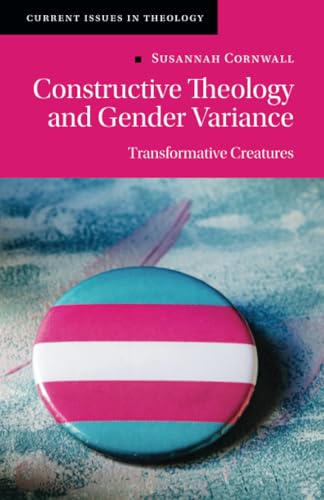
Susannah Cornwall is professor of Constructive Theologies at the University of Exeter, UK, publishing extensively on issues of sexuality and gender. Cornwall is an Anglican theologian and was recently a member of the Theology Working Group for the Church of England’s Living in Love and Faith project. In Constructive Theology and Gender Variance, Cornwall weaves together the doctrines of creation, humanity, Christ, and the last things to argue that humans are “transformative creatures.” As “transformative creatures,” gender is something we inherit and receive (for we are animal creatures), while also being something we shape and hone (for we are co-creators with our Creator God). Consequently, every human should enjoy the dignity of agency to self-determine one’s gender identity. Christian theology has the required resources to cast a compelling vision for church and society, where gender becomes the “locus of euphoria rather than dysphoria” (p. 12).
Obstructing Cornwall’s euphoric vision for gender variance stands the strange axis of “conservative evangelicals” (she lists Oliver O’Donovan, Mark Yarhouse, Denny Burk, Peter Sanlon, Andrew Walker, among others) and “gender-critical radical feminists” (e.g., Kathleen Stock, Sheila Jeffreys, and Joanna Williams). Both groups oppose gender diversity because they are entranced by an insidious “biologism,” namely, the unjustified fetishization of the biological body over the autonomous mind. Indeed, the axis’s appeal to “‘common-sense’ biology” troubles Cornwall as arbitrary, for such “biologism” inconsistently ignores the “irreducible or incontrovertible” biology of intersex people. The axis stubbornly and “ardently reject[s] the complex realities presented by the scientific consensus” (p. 66). Conservatives and feminists may trot out detransition stories and trans-related rape cases, but these amount to scaremongering smokescreens that distract from the real hurt experienced by concrete trans individuals.
The energy invested in such tactics reveals that the supposed sex/gender binary is not as secure and stable as often assumed. In Shakespearean key, the axis “doth protest too much.” They do not interrogate what they presume is “common-sense truth” because they cannot handle the actual truth. They have too much to lose, religiously, socially, and politically (p. 140). It remains easier for traditionalists to gaslight trans individuals that their “self-understanding is not in fact trustworthy” (p. 134), a move that she contends shares worrying parallels with “hierarchized race ideology” (p. 287). In short, we often fail to interrogate common-sense biology properly “for fear of what will crumble if we do” (p. 287).
To expose the conceit of a sex/gender binary, Cornwall explores several deeply theological questions: What really counts as the “givenness” of creation? How do we determine “licit limits” within creation from which humans may legitimately alter or augment the body? Why do we often give the body greater “authority” over the mind, insisting that the mind must align with the body? Is not the mind (including brain sex) part of the body? If Christian conversion represents a change in spiritual identity, could it offer a legitimizing parallel for gender transition?
Constructively, Cornwall marshals evidence from Scripture (esp. 2 Cor 5), tradition (e.g., Irenaeus and Nyssen), and experience to argue for a “gender theology in the optative mood” (p. 251). Creaturely existence is not constrained by a rigid creational blueprint. Rather, “To be human is to be in motion, continually in the process of constituting others as they also constitute us” (p. 211, emphasis original). Cornwall emphasises the inherent generativity of creatures, where God designs humans to exercise autonomy creatively. Importantly for Cornwall, this is no gnostic rejection of creation but the means to live into creation more authentically (p. 130). Her argument thus climaxes with a repeated refrain: “In Christ, everything has changed, even that which appears to have stayed the same” (p. 366, emphasis original).
Cornwall’s case is passionately argued, well researched (in terms of the breadth of literature surveyed, even if depth of engagement is somewhat lacking in places), and attempts to give various interlocutors a fair trial. Given Cornwall’s involvement in the LLF process, Anglicans would do well to read a clear account of Cornwall’s constructive theology to understand better some of the theological heavy lifting that undergirds more progressive accounts of gender and sexuality.
At the heart of Cornwall’s case lies a crucial question for our (and every) age: what is the dogmatic function of (human) nature from creation to consummation? Methodologically, given Cornwall’s Anglican moorings, whose historic formularies repeatedly emphasise the supreme authority of Scripture (e.g., Article 6; Canon A5), it is jarring how firmly she maintains that questions of “nature” and “givenness” are best interpreted through human experience. But Cornwall is adamant: personal experience offers the authoritative lens through which to read Scripture. As such, it is no surprise that when Scripture gets mentioned, it is typically a few verses divorced from their immediate literary and redemptive-historical context. Other Anglicans may justifiably wonder whether Article 20 may offer Cornwall sage advice, namely, that it remains hermeneutically illegitimate to “expound one place of Scripture that it be repugnant to another”!
Heeding such wisdom, we may discern how the Bible consistently witnesses to the enduring moral authority of the created order, running from creation through to consummation. In creation, “Adam and Eve” function literarily and theologically as prototypes of fixity rather than mere parents of fecundity, an exclusive norm for all humans, not just the statistical majority. Before sin and death entered the world, a sexual correspondence exists between “male and female” (Gen 1:27). Humans were formed for fruitfulness (not exhausted by but certainly including procreative fruitfulness), where sexed form founds function and function fits form. Tragically, this structurally ordered peace of unambiguous sexual dimorphism was spiritually, socially, and somatically misdirected (although not destroyed!) in the fall, spiritually and socially redirected in redemption through Christ the theandric Lord (the one and the same Creator and Redeemer who valorises the vocation of singleness), and will be somatically transformed in the consummation, a restorative transformation contoured by original creation (1 Cor 15:35–58). What this reveals is that the metaphysical “structure” of sexual dimorphism endures throughout the divine drama of creation to consummation—a witness to the goodness of creation and the faithfulness of the Creator.
Susannah Cornwall’s work raises important theological questions that require careful theological attention. Cornwall’s caveat against assumption remains salutary, even if her case remains unconvincing. More euphorically, the scriptural story encourages us that we can know who we are and what we are when we know whose we are and where we fit within his story.