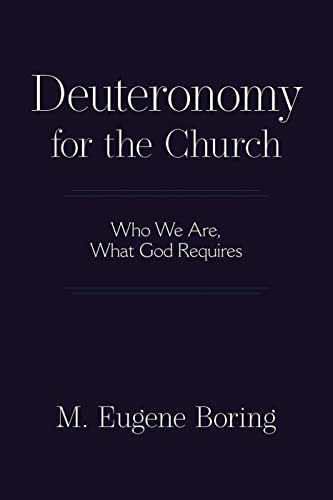
Deuteronomy is arguably the most theologically and ethically rich book in the entire Old Testament. Indeed, it has been said that Deuteronomy stands at the very center of Old Testament theology (Gerhard von Rad, Studies in Deuteronomy, trans. David Stalker [London: SCM, 1953], 37). Yet Deuteronomy has proved particularly challenging for readers to appropriate as Christian scripture. Deuteronomy for the Church is an attempt to help Christians, especially pastors and teachers, hear, interpret, and mediate the message of Deuteronomy for the church.
Before retiring, M. Eugene Boring was the I. Wylie and Elizabeth M. Briscoe Professor of New Testament at Brite Divinity School. Boring’s expertise in New Testament studies has both positive and negative effects on the book. On the positive side, Boring provides extensive discussions of New Testament texts that appropriate passages from Deuteronomy, are influenced by its theology, or orient readers hermeneutically to hear and understand the message of Deuteronomy. Concerning this final point, Boring includes a helpful discussion of New Testament texts that speak of Christians being incorporated into Israel (ch. 11). Hermeneutically, this widens the perspective of the identity of the “all Israel” to whom Deuteronomy is addressed (p. 178). On the negative side, it sometimes leads to discussions that are insufficiently informed by scholarship on Deuteronomy. One example is his attribution of the typical elements present in Hittite treaties, which are commonly said to be shared by Deuteronomy, to Esarhaddon’s Succession Treaty (EST) despite the fact that EST lacks a historical prologue, blessings, instructions about recitation, and instructions about the deposit of the tablet (p. 226). Another example is his discussion of the terminology used for law in Deuteronomy (pp. 274–78), which fails to identify the crucial role these terms play in connecting the stipulations of the Deuteronomic Code to Moses’s encounter with YHWH at Horeb.
A key theme that weaves its way throughout this book is Boring’s identification of Deuteronomy as a “strange but true story” (pp. 25–26). This identification of Deuteronomy as a story is, perhaps, the key contribution of Boring’s book. According to Boring, the story depicted in Deuteronomy extends from creation, through the history of Israel as God’s people, to Deuteronomy’s version of the consummation (pp. 74–86). The identification of Deuteronomy as a story has important implications for how Deuteronomy is read by the church. As readers with their own unique stories encounter the story of Deuteronomy, Deuteronomy’s story challenges and transforms their story (p. 59). Like later generations of Israelites who did not experience God’s acts of deliverance in Egypt, Christians are challenged to make this story their own (pp. 24, 221).
Viewing Deuteronomy as a story also has important implications for how the central law section of Deuteronomy (Deut 12–26)—the Deuteronomic Code—should be understood. Boring notes that the Deuteronomic Code is preceded by an extensive sermon (Deut 4–11) that situates these stipulations in the context of Israel’s story (p. 26). This context transforms these stipulations from the category of law to the category of ethics (p. 64). For Boring, the ethical teaching of Deuteronomy is not received by treating these stipulations as law but by living within the story of Deuteronomy (pp. 278–79). A person who lives within this story, for example, will not ignore their neighbor’s wandering ox even if no punishment is tied to the stipulation in Deuteronomy 22:1. Rather, a person who lives within this story cannot see their neighbor’s wandering ox and take no action (p. 279). As readers are shaped by this story, they develop discernment and can “improvise” what it means to be obedient to God in the ever-changing situations they find themselves in (p. 280).
A key emphasis for Boring is the importance of interpreting Deuteronomy through the lens of historical criticism (pp. xi, 87–88). In chapters 5–8, Boring carefully distinguishes the narrative world of Deuteronomy from the history of Israel as it can be reconstructed by historians, the history of how Deuteronomy was composed, and the process by which Deuteronomy became canonical scripture. He maintains that the narrative world created by Deuteronomy differs sharply from these stories. According to Boring, although “Moses was not a fictional character” (p. 111), he did not deliver the speeches in Deuteronomy, which were written centuries later (p. 97) and reached their canonical form towards the end of the exile (p. 105). The rules about חרם warfare, which entailed the complete annihilation of the Canaanites, were not delivered by God (p. 202), were never carried out (p. 203), and were written at a time when the inhabitants of Canaan no longer existed (p. 202). He asserts that Deuteronomy can be said to have “Mosaic authority” and “a historical core that goes back to the exodus period and to Moses himself” but only in the sense that Deuteronomy developed from a tradition that had the figure of Moses and the events of the exodus at its foundation (p. 97). As a result, his analysis at times focuses on the narrative world of Deuteronomy while at other times focuses on the message of Deuteronomy for its readers in exile. Needless to say, this approach will prove problematic to readers who hold to a traditional understanding of biblical inerrancy and the composition of Deuteronomy. Nonetheless, Boring’s presentation provides an excellent window into how non-traditionalist readers can appropriate Deuteronomy as Scripture.