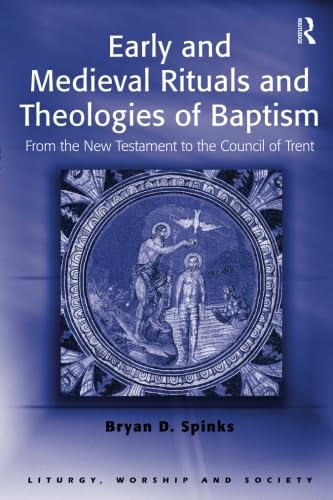
Bryan Spinks is Professor of Liturgical Studies at Yale University, and an acknowledged expert in the field. This volume is published simultaneously with its companion by the same author on Reformation and Modem Rituals and Theologies of Baptism. The modest size of this book means that it has to function more at the level of a survey than a detailed exposition, but the notes and bibliography provide the wherewithal for pursuing any aspect of the survey in greater depth. Overall the interest seems to fall more on ritual than on theology. The work might best serve as a handbook on the development of baptismal ritual practices and doctrinal understandings, with a heavy emphasis on their diversity from the New Testament on. Few readers will fail to encounter something new in these learned pages, such as the glimpse (strictly beyond the chronological range of the book) of baptism in ‘deep green jade water’ in sixteenth-century Mexico. Yet as an introductory manual it unhelpfully leaves several words and phrases, for instance, in Latin and Syriac, untranslated (a glossary would have been welcome), which tends to highlight the technical character of much of the material under review. It is not always accurate in details: the Nag Hammadi neither was, nor was found in, a rubbish dump, and the Latin-less masses need precision in a phrase such as extra ecclesiam non salus est.
Spinks displays a special interest in the significance of Jesus’ own baptism by John, going so far as to state in his concluding summary that:
Both historically and theologically all baptismal rituals look back to the baptism of Jesus in the Jordan. In so far as that event … crystallizes the whole salvific work of God in Christ both for, and in place of, humanity, it is foundational, and all liturgical rituals need to be grounded in that one baptism.
This is as much a partial and normative judgement as one that is in fact borne out by the territory Spinks has traversed, and is reflected in the disproportionate attention paid to Jesus’ baptism in his ten pages on the New Testament. Here he may reflect the influence of T. F. Torrance and the voluminous reports of the Church of Scotland’s Special Commission on Baptism which he masterminded for a decade. However, Spinks does not evince Torrance’s one-sided preoccupation with infant baptism, which rarely receives more than incidental notice in this book.
Most readers of Themelios are likely to be drawn more instinctively to the second of Spinks’s books. Certainly most Protestant believers in the West will be bemused by what must seem the ritual extravagance of later patristic and medieval services of baptism. Yet the attenuated and diluted baptismal practices, to say nothing of theologies, of wide reaches of evangelical Christianity could surely benefit from exposure to some of the richness of imagery and actions displayed in this study. It builds on recent scholarship across a wide canvas, without always endorsing it (e.g. on the Hippolytan Apostolic Tradition), and will instruct students of baptism who do not necessarily share its author’s predilections.