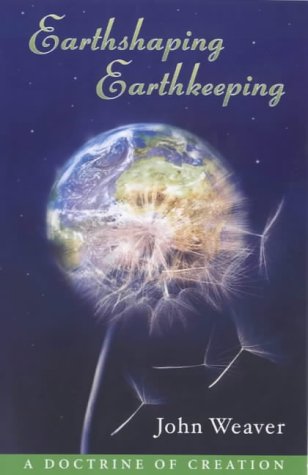
This book’s title initially leads one to expect that it is a theological discussion of environmental and ecological issues. However, while it certainly includes this, the book is actually much more wide-ranging, and is in fact (yet) another exposition of the interaction between the sciences and theology, this time by a geologist turned Baptist minister, currently Director of Pastoral Training at Regent’s Park College, Oxford. For John Weaver, ‘we explore the meaning and purpose of the world and universe, of which we are a part, through Scripture, church tradition and science’ (ix).
So, Part 1 examines the biblical creation stories, in their Ancient Near Eastern cultural context, and asks what sort of God is revealed. Somewhat surprisingly, the exposition of Genesis is articulated assuming a sixth-century BC composition, and J and P sources (chs 1–3). However, this does not adversely influence the theological conclusions, many of which may be affirmed without hesitation. Here Weaver draws particularly on Wenham, Westermann, von Rad, Brueggemann, Atkinson and Ellen van Wolde. There are some very brief New Testament reflections (43–45).
Part 2 concentrates on the ‘stories of science’—the mainstream scenarios of cosmological, planetary, chemical and biological evolution (presented essentially as factual)—along with such issues as boundary questions and apparent design, and again asks what sort of God is being revealed.
Part 3 ‘tries to make sense’ (x) of the stories, bringing them together in a holistic understanding of creation, with an appreciation of the transcendent and immanent Creator God who calls us into a covenant relationship of worship and care for the planet.
For Weaver, the order of the Genesis creation week may be related to the cosmological and geological history of the earth (31–32, 105, 155 note 19). Here he refers back to his rather similar-looking volume In the Beginning God: Modern Science and the Doctrine of Creation (Regent’s Study Guides 2, 1994).
Following a now well-worn path, Weaver resists the ‘conflict myth’ and asserts the complementarity of science and theology (81–84). ‘The question “How?” of science directs our rational minds to ask “Why?”, a question that belongs to philosophy and theology’ (92). Science addresses theology with respect to: the nature of physical reality; the beginning and end of the universe; and the ability and limits of the human mind in understanding creation (102). Theology addresses science with respect to: a holistic view of the universe; answers to boundary questions; and the all-encompassing will of God (104). The methodologies of science and theology are ‘not totally different’ (107). There is a fleeting acknowledgement that science involves interpretation, personal commitment and judgement in the search for truth about objective reality (100).
In itself, then, this book is an attractive, concise presentation of a variety of important topics in the complex interaction of the sciences and Judaeo-Christian theology, from a broadly evangelical perspective. As such, it makes a useful introductory text for those new to this challenging discipline.
However, when considered alongside the numerous other publications on the subject now available, Weaver’s contribution offers very little fresh material, despite its own style and emphases, and hardly ‘fills a waiting niche’ as is claimed by a cover commendation. That niche is already overcrowded by works by the likes of Polkinghorne, Peacocke, Ward, Barbour, Berry, Van Til, Wilkinson and McGrath, to name but a prominent few. In this respect, Weaver’s book may add to what free market theorists would call ‘choice’, but arguably only serves to expand a ‘multiplicity of sameness’.