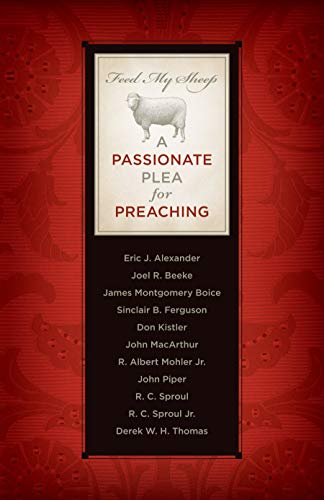
As media saturation has continually distracted those in contemporary Western culture with undersized attention spans, the patience for deep, biblically rich preaching has become rare. It is no surprise then that deep, biblically rich preaching is a dying art. In spite of the necessary priority of authoritative, biblically grounded, expositional, transformative preaching as essential to growth in Christ, many voices today fail to give preaching the value it deserves. This calls for prophetically affirming the centrality of biblical preaching as a definitive mark of the true church. Feed My Sheep: A Passionate Plea for Preaching is such a call.
This short book is replete with stirring essays that are sure to awaken greater conviction for feeding God’s people through his preached Word. It is an outstanding collection by some of today’s leading preachers who are models of what they advocate. For all the negative effects the Internet has on us, it is wonderful that in seconds sermons by these authors can be on one’s iPod in case you are wondering what the preaching they are calling for sounds like. It is good that publishers saw fit to reprint the 2002 edition in a more attractive hardcover format. I will try to summarize the main point of each chapter with one concise sentence and then offer a brief evaluation.
- Albert Mohler, “The Primacy of Preaching.” Preaching is at the heart of ministry and must take central priority in a pastor’s life, motivating and defining the way he spends his time.
- James Montgomery Boice, “The Foolishness of Preaching.” Preaching must be grounded in the absolute authority of the Bible.
- Derek Thomas, “Expository Preaching.” The God-breathed nature of Scripture means that preaching must enable people to understand the whole Bible and thus must be expository.
- Joel Beeke, “Experiential Preaching.” Reformed ministerial piety and experiential preaching must define our preaching.
- R. C. Sproul, “The Teaching Preacher.” We must know and teach the truth.
- R. C. Sproul Jr., “Preaching to the Mind.” Changed hearts and minds depend on changed minds through the preached Word.
- Sinclair Ferguson, “Preaching to the Heart.” All biblical preaching is preaching to the heart.
- Don Kistler, “Preaching with Authority.” Get some backbone, and preach with the authority Christ himself has given you.
- Eric Alexander, “Evangelistic Preaching.” The whole Bible has saving and sanctifying power, so we should expect people to be converted when we preach any part of it.
- John Piper, “Preaching to Suffering People.” Preaching is trying to accomplish the hardest work in the world: to change the minds and hearts of fallen human beings and make God so precious to them that they count it all joy when trials come, exult in their afflictions, and say in the end, “To die is gain.”
- John McArthur, “A Reminder to Shepherds.” Point to the message (the gospel), not the messenger.
The preaching that Feed My Sheep calls for is a necessary requirement for true conversion, abiding in Christ, strong churches, and growing individuals. One might ask if the authors overstate the importance of preaching relative to other means of grace (e.g., the Lord’s Supper, baptism, fellowship, service, prayer, Scripture meditation). But as one seeks to answer that question, solid expositional preaching on issues related to that question seems to be the most important means of getting to the truth of the matter. And perhaps that shows that the book does not overstate the importance of expositional preaching. As the chapter summaries show, this is not the kind of book that evangelicals should have any significant disagreements with. Rather, they should pray that its message would be heard and heeded.
While each chapter highlights important elements of preaching, especially important are the chapters by Beeke, Kistler, and Piper. Along with Ferguson’s chapter, Beeke dispels the notion that preaching conveys information merely to be added to a purely intellectual database. The content of preaching must reach the heart and have a sanctifying effect. Kistler’s chapter on preaching with authority flies in the face of postmodern apathy toward truth and calls preachers to have conviction and backbone that should come from preaching God’s Word. Piper’s chapter calls the preacher to show and teach his people how to delight in God and have hope in the midst of the pervasive suffering all in our fallen world will encounter. Preaching hard truth about the relentless difficulty in our cursed world will prepare Christians to live for what lasts. Today’s Christian often views authoritative expositional preaching like meaningful church membership—as an optional spiritual discipline that may or may not fit into what they think they need to help them with their current spiritual condition. If pastors and their flocks take to heart the message of this book, they will rightly dispatch that unbiblical consumer mentality and practice a vital antecedent of revival with the fervor it deserves.