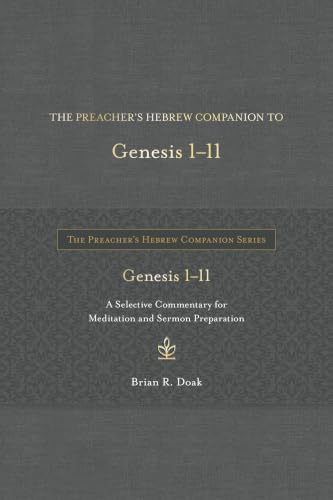
Brian R. Doak’s commentary marks one of the first entries in an exciting new line-up of original-language resources. According to the series editors, Jonathan G. Kline and Sean McDonough, the aim of the series is to support busy preachers by providing guidance through the Hebrew text. Their approach empowers preachers “to integrate original-language exegesis and homiletics” (p. xi). To say things differently, this series aims to help students, clergy, and other readers bridge the gap from introductory language study to fluent reading of the biblical text—which is where the real payoff and enjoyment come. Incontrovertibly, they succeed in this endeavor.
The book consists of ten sections, each comprised of a select set of verses accompanied by lexical and grammatical information. Each passage ends with a brief section titled “From Text to Sermon,” in which the author highlights particular insights. The specific passages include “The First Acts of Creation” (Gen 1:1–5), “The Creation of Humans” (1:26–31), “The Sabbath” (2:1–3), “The Man, The Animals, and the Woman” (2:18–25), “Man, Woman, And Serpent” (3:1–7), “Consequences in the Garden” (3:14–21), “Brother Murders Brother” (4:1–16), “God Decides to Flood the Earth” (6:1–22), “God Restores the Earth After the Flood” (8:20—9:7), and “The Tower of Confusion” (11:1–9). Doak is to be commended on his fine selection of texts as they represent some of the most important events of this pericope of Scripture from the perspective of biblical history, theology, and exegesis.
After a brief introduction to each main passage, the Hebrew text is presented in an interlinear format. This includes parsing information, contextual glosses, and a transliteration of the passage as a pronunciation help for those whose Hebrew is at a rudimentary level. That said, given the technical nature of the transliteration, it is regrettable that there is no accompanying sigla guide.
With respect to glosses, it was a prudent decision to intentionally err on the “literal” end of the spectrum (see p. xiv). However, in some cases, more nuance or texture could have been added. For instance, to include “basket” as a contextual gloss for “ark” in Gen 6:14 borders on the ludicrous, particularly when the canonical connection to the papyrus vessel of Moses is well-established in the comments (see pp. 192–92). Additionally, there is strong linguistic evidence to support the assertion that “reeds” is not only an acceptable alternative to “nests/rooms” but also a better rendering of the Hebrew term קִנִּים (Gen 6:14). Unfortunately, Doak fails to note this. Finally, the “sweet” aspect of the “smell” of Noah’s sacrifice, i.e., רֵיחַ הַנִּיחֹחַ (Gen 8:21), is not mentioned in Doak’s analysis of the flood (pp. 172–245), despite “sweet” being the most “literal” gloss.
One might argue that it would have been prudent for the author to consistently use precise nomenclature (wəqātal/yiqtol) for the prefix/suffix conjugations, rather than “perfect/imperfect” (cf. p. xxi). As Doak himself maintains: “Hebrew does not function strictly on a tense system in terms of past, present, and future” (p. 147). In light of this, why use such imprecise terminology at all?
Syntactically speaking, Doak’s attention to detail is exceptional, despite there being no references to the standard Hebrew reference grammars. For instance, in his discussion of humanity “ruling over” the earth (Gen 1:28), Doak judiciously states:
Translators must … be careful to avoid … “illegitimate totality transfer” … we would not want to rush to assume that because [these] verbs … describe slavery in some contexts, they must be understood with explicit reference to slavery here. (p. 29)
Elsewhere, Doak rightly maintains that while the translation of the conjunction כִּי in Gen 8:21 as “even though” rather than “for,” “since,” or “because” may, perhaps, be “stretching” the normal definition of the term, the conjunction here must be rendered as either a concessive or emphatic to best “understand the sense of the text. The theological and ethical question at stake here concerns why God decided to flood the earth upon seeing the utter wickedness of humanity (Gen 6:5–7) and yet here vows never to do this again—even while he observes that humans are essentially in the same moral mess as before” (p. 224). Such fastidious attention is most impressive.
One also appreciates Doak’s concern for literary sensitivity. For example, in translating Genesis 1:2, Doak renders תֹהוּוָבֹהוּ as “chaos and chaotic,” elegantly capturing the sound repetition of the original language (cf. Robert Alter’s “welter and waste”; noted by Doak, p. 8).
When it comes to preaching, Doak’s comments are consistent with the ecumenical beliefs stated in the Apostles’ Creed and will benefit most evangelicals (see pp. xvi–xvii). One example should suffice to illustrate this viewpoint. Doak opines:
As we think about how to illustrate the themes of Gen 9 … the rich world of film again comes to mind, especially the many cinematic plotlines that deal with the reciprocity of justice (either fulfilled or denied) … [both] The Revenant (2015) and True Grit (the original 1969 version or the 2010 remake), depict wounded characters in search of blood-for-blood justice. Viewers of films like these can consider how the search for justice either can turn into (unholy) vengeance or can rightly fulfill the demands of ethical reciprocity (p. 245).
Visually speaking, things are beyond beautiful! The typeface for the Hebrew font is superb (all diacritical marks for MT pointing are clear) and the effective use of white space, special shading, and ornate, intricate designs neatly divide the text and catch the eye. The opaqueness of the pages also prevents the facing text being obscured by that on the next page.
One critique is that the absence of “Author” and “Extrabiblical References” indices reduces the user-friendliness of the book. Also, since only two commentaries are noted in the “works cited” section—E. A. Speiser, Genesis: A New Translation with Introduction and Commentary, AB 1 (Garden City, NY: Doubleday, 1964) and Bruce K. Waltke with Cathi J. Fredricks, Genesis: A Commentary (Grand Rapids: Zondervan, 2001) —most users would have benefited from an annotated “for further reading” list. Lastly, a “ribbon marker” bookmark would also have been a nice touch.
This book will be of immense assistance to students in Bible colleges, Christian universities, and seminaries, pastors, and laypeople who are curious about biblical studies. I highly recommended it!