When asylum seekers and refugees arrive in a new land, they come carrying stories—not just about what made them leave their homeland, but about the origin and meaning of life, how they make sense of the world, and what is most important to them. For those who seek to welcome foreigners and desire the story of Jesus the Messiah to take root in the soil of every people group—even if that group is transplanted in a new place—it is essential to listen to those people’s stories.
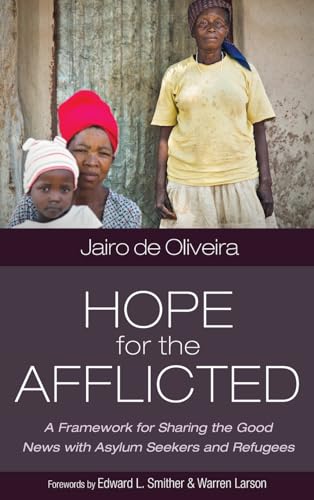
In Hope for the Afflicted, Jairo de Oliveira seeks to tell the story of the Fur people of Darfur, Sudan, by sharing their stories in their own words through his ethnographic interviews. Theirs has been a story that involves much suffering, both in their homeland and continuing into their asylum and refugee experiences in Jordan, where they have struggled to be accepted or flourish after resettlement. Because of these negative experiences at the hands of fellow Muslims, some Fur find themselves questioning Islam and are open to following Jesus. In these pages, de Oliveira proposes a contextualized evangelism and discipleship model for Christian workers involved with the Fur people. Furthermore, his proposal is relevant for those working with other displaced people.
As the title suggests, the theme of de Oliveira’s work is hope. Chapter 1 examines the God-centered hope that remains even for the displaced, and how the church can be involved in carrying that hope to the hurting. Chapter 2 discusses church planting contextualization issues related to the culture and language of the Fur people, and points out the implications of Oliveira’s research for Sudanese, Jordanian, and international believers around the globe. Chapter 3 delves into Sudan’s cultural and religious history, particularly focusing on the ongoing conflict in Darfur. Chapter 4 explains the current challenging circumstances of the Fur people living in Jordan as asylum seekers and refugees, where their hope for a better future has been frustrated by discrimination.
Chapter 5 is an account of de Oliveira’s ethnographic interviews with the Fur and concludes with drawing out themes of discrimination, war, displacement, exile, and suffering, which were deeply relevant to all interviewees. “Before the war, my life was wonderful,” reminisced one. “My sisters would help my mother cook for my family, and I would play with my brothers. It was when the war broke out that everything changed” (p. 93). These stories do not yet have a happy ending: “Some people say the Sudanese [in Jordan] are doing well because we no longer face the war in Darfur. This opinion reveals a simplistic look at our situation. In general, people don’t know the day-to-day adversities we face here in Jordan. The trust is that we are still on a journey of daily survival” (p. 98).
The final two chapters describe a contextualized model of evangelism and discipleship that considers themes pertinent to the Fur, asks how God is reaching out to meet them in those areas, and mentions areas where further research is needed. Oliveira examines how the Bible addresses these themes and how Christians can communicate these biblical truths to “constructively engage the Fur people’s worldview” (p. 125) and offer hope in their daily realities. This is accomplished by drawing principles and applications from specific Scripture passages and addressing apologetic issues likely to surface. He also looks forward with hope towards a discipleship process involving continued growth in grace for Fur believers and believers of other nationalities who are connected with this community. De Oliveira also shares “fruitful practices,” such as “praying with Fur individuals for peace in Sudan and throughout the world” (p. 179), which will help Christians from other nationalities connect meaningfully with the Fur.
This book was originally a doctoral dissertation; therefore, it contains robust research and academic inquiry. Still, it is eminently practical and capably written by someone involved in ministry among the Fur people in Sudan and the Middle East for many years. The strength of this work is the culturally-aware, exegetically-thorough breakdown of how biblical truth can be contextually communicated in ways that bring hope to the afflictions that the Fur—and others who have experienced similar life circumstances—have endured. While reading the book, I wondered what is being done in local Jordanian congregations to welcome and share the Gospel with the Fur people. Further research may evaluate the perspectives of Jordanian believers to determine whether discrimination is or will be a problem within the Jordanian Christian community for the Fur who may decide to follow Jesus.
While the specificity of the ethnographic research means that some particularities of the findings will not be broadly applicable, de Oliveira has provided a strong example of how ethnography and exegesis can provide synergy when seeking to share the gospel with people on the move. I recommend this book to those working among asylum seekers and refugees from Darfur and other war-torn areas, those involved in migration studies, and those interested in the crucial intersection of ethnography and exegesis in cross-cultural church planting ministry, particularly among Muslims.