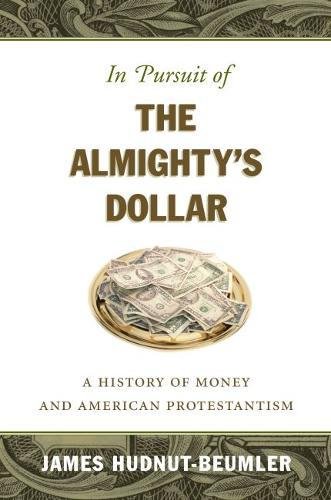
Weekly offerings and giving envelopes are nearly as common as the weekly sermon in contemporary Protestant churches. However, as in other aspects of church life, what is now seen as tradition was once new and innovative. James Hudnut-Beumler retells the advent of these practices and many more as he traces the history of fundraising and spending in American Protestantism (mostly in mainline denominations) from 1750 to 2000. He draws most heavily from numerous books about church finance and fundraising, but also utilizes denominational annual records and minutes, census data, sermons, diaries, account books, and architectural blueprints to tell the story of how American Protestant churches have raised, spent, and been shaped by money. In Pursuit of the Almighty’s Dollar focuses on three aspects of church finance: (1) fundraising appeals, (2) fundraising methods, and (3) the way Protestants have spent money—specifically on buildings and ministerial labor.
Following the First Great Awakening and the American Revolution, church competition and disestablishment resulted in a massive shift from public to private support of religion. This shift, which turned every pastor into “a development officer among his own people” (15), birthed unique and voluminous literature on church finance and fundraising. Hudnut-Beumler examines this literature, telling the story of the strategies and terms religious leaders have used to inspire giving. For example, the term “systematic benevolence” became popular in the years leading up to the Civil War as Protestant leaders called on Christians to give in a planned and proportional way to support the churches and to fund the multiplying benevolent and mission agencies of a booming Protestant culture. Post-Civil War America witnessed the publication of many books advocating tithing as an act of obedience to God. Hudnut-Beumler argues that the tithe did not become common until late in the nineteenth century as more and more leaders spiritualized giving and focused on biblical principles rather than mere institutional needs. Appeals to “stewardship” began in earnest during the Progressive Era, largely among Social Gospel advocates like Josiah Strong and Washington Gladden. Nearly all segments of Protestantism in the past one hundred years have adopted the concept of “stewardship” to encourage everything from environmental care to family budgeting.
In Pursuit of the Almighty’s Dollar also tells the story of fundraising methods, arguing that developments in method have often been more tied to cultural trends and pragmatic considerations than to theological concerns. In many churches, methods used during the establishment era—such as pew rentals, poll taxes, and property taxes—were still used for much of the nineteenth century. These methods eventually died out as churches opted for a completely voluntary system, more in step with the free-market nature of American religion. Weekly offerings became normal in most churches by 1890, and unified church giving was proposed as a solution to the problem of competing needs in nineteenth-century Protestantism. The Every Member Canvass, annual pledge cards, and the divided offering envelope are just a few of the methods popularized in the mid-twentieth century as technique and businesslike precision began to supplant appeals to biblical stewardship as the dominant emphasis in church fundraising. While professional technique has been on the rise, Hudnut-Beumler argues that the twentieth century has witnessed a tension between biblical motive and professional technique in Protestant approaches to fundraising.
Four chapters break up the main narrative of this book by outlining how Protestants have spent money on church buildings and ministerial labor. Hudnut-Beumler argues that church buildings have taken on new forms as the vision of what a church should be has changed. For example, the small church buildings of early America—good for meeting and preaching—gave way to larger buildings, as programs and staff were added to meet more needs of congregants and the community. The chapters on ministerial pay and experience (including a chapter on the experience of ministers’ wives) tell a story of decreasing income and status, which has intensified over the past thirty years.
This book is not a comprehensive economic history. The author’s choice to focus more narrowly on church fundraising enables him to provide a concise and lucid narrative of this neglected but important topic. However, his narrow focus in other areas proves a weakness in at least two important ways. First, Hudnut-Beumler, dean of the divinity school at Vanderbilt University, chooses to study mainly upper-class, mainline denominations. Therefore, he gives little attention to large segments of Protestantism, such as Baptists and Methodists in the nineteenth century and Pentecostals in the twentieth century. The result, then, is that the reader gets a well-researched description of Social Gospel attitudes toward money and a careful interpretation of the economic woes of late-twentieth century mainline denominations. The book would have been even more helpful if it provided an equally thorough description of rural church fundraising or the ways in which booming evangelicalism funded itself in the mid-twentieth century. Second, the author’s narrow focus on economic factors leads to some less-than-satisfactory interpretations—especially of the past 50 years. Rather than taking divergent theological beliefs into account, Hudnut-Beumler explains the decline of mainline Protestant churches and the parallel rise of conservative churches almost exclusively by economic and social causes.
Despite these imbalances, In Pursuit of the Almighty’s Dollar is still an important book for any pastor, church administrator, or student of American religion. It provides both a compelling, well-researched history and significant insight into contemporary giving and fundraising practices.