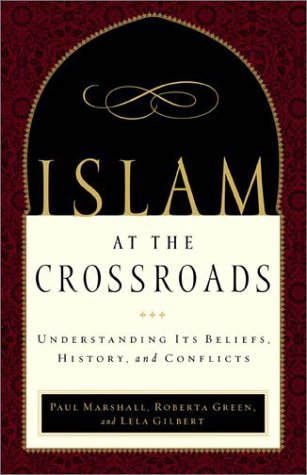
How are we to make sense of world events where Islam holds centre stage? How are we to begin to relate to colleagues and friends who happen to be Muslim? How are Christians to understand and respond to one of the great spiritual and intellectual challenges that face them?
Well, we could hardly do better than to buy and study Marshall, Green and Gilberts’ Islam at the Crossroads. A great deal of content is packed into its brief 113 pages, including a useful bibliography. There is a clear portrayal and appreciation of the extraordinary diversity of Islam and the very wide gulf that separates Islamic and Western thought. Though clearly written for the American reader, nearly everything is relevant here in the UK.
The book starts with a chapter on ‘What Muslims Believe’, and here is the only place where the book disappoints. There is a good account of Islamic doctrines and beliefs to which all Muslims will assent, but there is no real appreciation of the deep and intense devotion to, and veneration of the Prophet Muhammad that goes far beyond religious observance. Neither is there an insight into the very literal and magical way in which the Qur’an is revered as God’s word: a way that is entirely different from the Christian view of the Bible, and fundamentally alien to Western thought forms.
That said, the book goes on to give a fascinating perspective on Islam’s history from its phenomenal growth and its flourishing in the fifth, sixth and seventh centuries, to its gradual decline and eventual collapse in the face of the colonial powers in the twentieth. This is done in a way that throws some light on such features as suicide bombers, the behaviour and motivation of contemporary political groupings, and ‘Islamic extremism’. It illustrates the divisions and rivalries that started in earliest times and plague Islam today. It begins to explain the deep sense of shame and frustration that many Muslims feel at what they perceive as Western dominance and the corruption of Islamic ideals in the face of western commercial and political power, with even their own ostensibly independent leaders ruling from a Western philosophical basis, having abandoned an Islamic one. We begin to appreciate the deep aversion that Muslims feel to the presence of American and other Western soldiers on Islamic ‘holy ground’, and the centrality of the presence and problem of Israel. We see why Muslims in the West do not necessarily ‘buy in’ to the assumption, arising out of our experience of European immigrants, that they will feel as much loyalty to their adopted country as its indigenous peoples do. Most importantly, the authors contrast the American (and they could have added contemporary British) abandonment of the historical perspective with the ever-present reality of Islamic history in the hearts and minds of Muslims, and its consequent motivating power.
Perhaps the book’s most helpful contribution is to expose to us the huge gulf of misunderstanding that separates Islam from the West, enabling us to see that what often appears to us as rhetoric and posturing comes out of an entirely different world view. It then lays the foundation for a better understanding of what we have come to call ‘Islamic fundamentalism’. Throughout the book the authors manage to keep a balanced position. They are not afraid to offer trenchant criticism in areas such as the treatment of women, and are clear on the quite fundamental differences between Islam and Christianity.
All Christians should take an educated interest in Islam. Some must specialise and read deeply and widely. I suggest that for both, Islam at the Crossroads is a must.