Within the world of biblical studies and early Christianity, there is hardly a more divisive and controverted question than the question recorded on the lips of Jesus in each of the synoptic Gospels, “Who do you say that I am?” (Mark 8:29; Matt 16:15; Luke 9:20).
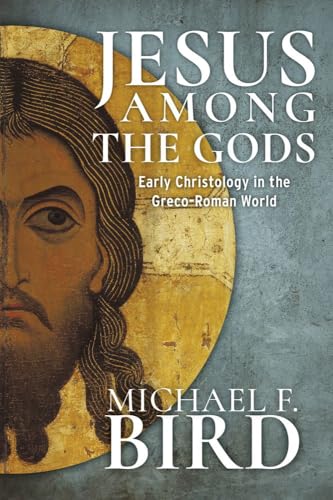
Michael F. Bird, Deputy Principal and Lecturer in Theology at Ridley College, explores the fundamental issues surrounding the nature and identity of Christ in his Jesus Among the Gods. The complexity of the issue surrounding the identity of Christ demands a detailed exploration of multiple facets, and Bird comes at the issue in two ways. First, he is concerned “to demonstrate that ancient notions of divine ontology have been sidelined for too long in academic discussions of early Christology and it is time to retrieve them” (p. 2). And second, he seeks “to engage in a comparative analysis of Jesus and ancient intermediary figures with a view to showing what is distinctive about Jesus’ divinity in early Christian discourse” (p. 2). The two objectives and their respective subjects are interconnected yet separate, thus adding a certain double entendre to the book’s title. On the one hand, Bird is out to see how Jesus simply “is” ontologically in relation to other ancient conceptions of divinity. On the other, he is also eager to explore how Jesus stands out (or blends in) among many of the competing gods, heroes, angels, and kings of the early Greco-Roman world.
The first two chapters specifically address the “how” of Jesus’s divinity. For many, even some among those who hold to a high Christology, the thought of ontology is too fraught with anachronisms and non-biblical elements to be included in discussions concerning the nature of Christ. However, Bird unequivocally disagrees with proposals seeking to eliminate divine ontology from discussions of early Christology (p. 42). Gathering a remarkable collection of primary and secondary literature, Bird shows that notions of divine nature (ousia) permeated the literature of the day, both Greco-Roman and Jewish. However, he also makes a compelling case that divinity could be construed in different ways. He boils these down to two basic modes of divinity: absolute and relative. This means that there are those who are truly gods, with a nature that can be compared to the gods found in various mythologies, or a nature that aligns with the “creational and monarchical monotheism” observed in Judaism (p. 32). Furthermore, there are those who are celebrated and honored as divine beings and whose divine status “was ascribed as a reciprocal response to benefaction,” representing an “euergetic” divinity (p. 57). Bird’s argument is compelling as it allows him to challenge effectively the notion that incorporating Christ’s divine nature, as defined in the ante-Nicene and Nicene traditions, is an unnecessary imposition (p. 84).
The remainder of the book is a comparative study of Christ and various intermediary figures in Greco-Roman philosophy, mythology, Judaism, and even Gnosticism. Bird begins chapter 3 by providing an overview of the diverse interpretations of the role that intermediary figures played in early Christology. There are those who have marginalized the role played by these intermediary characters, whereas others have given them prominence, to the extent of making them the primary source of early Christology. Bird finds these accounts too simplistic. The parallels are there, but the similarities betray significant differences that cannot be papered over, even aspects of Christ that may be “genuinely innovative” (p. 117). Bird supports his argument by thoroughly examining the primary sources in chapter 4, which comprises a significant portion of his book.
It is satisfying to read Bird as he enthusiastically discusses the various ways that Christ seamlessly fits his era. Christ can be compared to the demiurge of the philosophers (pp. 119–28), the Logos of Hellenistic Judaism (pp. 128–70), and divine Wisdom (pp. 170–88). He shares similarities with angels (pp. 188–274) as well as with some descriptions of exalted patriarchs in early Judaism (pp. 274–94). And Christ is described in terms that bear a close resemblance to much of the ancient ruler cult (pp. 295–379). For all the similarities, though, there are also differences. These differences are not negligible but show that Christ simply cannot be explained satisfactorily by any of these categories. In truth, regardless of any potential similarities between Christ and Greco-Roman figures, the most striking fact is that the most notable parallels can be observed between Christ and the covenant God of the Old Testament: “What if the most appropriate analogue for Jesus’ divinity is not any singly one of the exalted humans or intermediate heavenly powers, but the God who resides above the powers?” (p. 388). It seems like Bird subtly suggests that his writing puts the past four hundred pages into perspective and offers a straightforward, almost inevitable response to the question of who the Christ is. On occasion, he exhibits angelic qualities, and his appearance can resemble that of a revered ancient ruler. Despite this, it is clear that early Christians considered Christ to be none other than Yahweh himself.
I regret the lack of explicit engagement on Bird’s part when it comes to the current debates surrounding the utility and significance of comparison. Although he mentions Jonathan Z. Smith in passing towards the end, it would have been advantageous to dedicate a few additional pages to further examine this matter.
This is a book of immense learning and remarkable zest. Bird is not an arid academic, and he writes with a good deal of verve. His Christian principles are patent, although it should not be mistaken for an attempt to disguise apologetics as scholarly research (p. 406). To get a robust understanding of early Christology, it is imperative to give this book a comprehensive read.