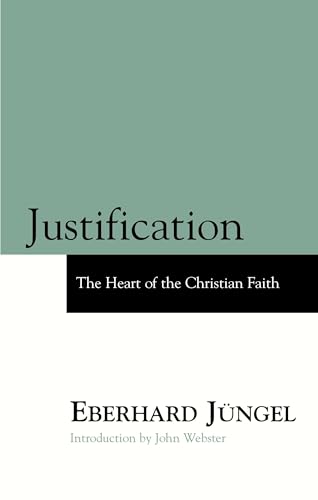
In justification (3rd edn.) Eberhard Jüngel has produced a valuable defence of the centrality of the biblical doctrine of the justification of the ungodly to God’s saving activity. Written in response to the Lutheran-Roman Catholic Joint Declaration on the doctrine (not so much a declaration, more a series of concessions!). Jüngel seeks to rebut the conclusions of the Declaration by restating the distinctives of Reformation (particularly Lutheran) soteriology, and calling attention to the incompatibility of Protestant and (post-tridentine) Catholic dogma concerning the ordo salutis.
This is not a book which interacts with New Perspective discussions of justification, and for this reason may be a frustrating/refreshing read, depending on whether you want Jüngel to wade into that particular debate. However, his exposition of the doctrine does show familiarity with certain aspects of modern NT scholarship (see, for example, his discussion of Rom. 7:14–25, on p. 217), although his sparring partners belong to the world of modern systematic theology (Barth, Pannenberg) or pre-Sanders NT studies (Bultmann, Käsemann).
In his helpful introduction John Webster signals Jüngel’s conviction that the doctrine of justification is a ‘special-status doctrine which identifies the centre of the Christian faith’ (vii). This conviction sees Jüngel using Luther to argue in chapter one for the justification article to be a part of a theology of creation (8–9), on the basis that the divine upholding of the world in light and life is an unceasing activity of justification, preventing creation from ‘falling back into chaos’ (10). This is part of a grander strategy in which Jüngel seeks to explain the doctrine of justification in terms of a doctrine of God, and specifically the triune God (ch. 3, p. 82ff.). For Jüngel, the reason God justifies is because he is himself righteous and righteousness must needs see righteousness prevail elsewhere. However God is righteous not merely in the sense that he is without sin: the triune God is righteous because he is in agreement with himself, he is ‘just in himself’. This trinitarian configuration of righteousness sees Jüngel arguing that when God declares the ungodly righteous he is not behaving in spite of his own righteousness but because of it; thus for Jüngel, there is no question of
God’s being righteous on the one hand when he judges sinners, but on the hand of making some downward adjustments to his justice and righteousness when he graciously justifies the sinner by allowing mercy and enacting grace before justice (85).
God’s actions are consistent with his character.
It is, however, with Jüngel’s exposition of substitutionary atonement (in ch. 5). that serious questions must be asked of this model. Accepting the substitutionary character of the Lord’s deadth on the cross (156), Jüngel advances the view that because it is God who grants righteousness, it is unbiblical to speak also of God is being conciliated by the sacrifice. Rather it is in his being prepared to accept the ‘transference’ of guilt form sinful human being to the sacrifical animal which is the basis of his justifying activity (160). In other words, the Son does not suffer judgement form the Father, but the Father is willing to accept the sacrifice of the Son as a satisfactory basis for the forgiveness of sins. However while it is right to emphasise the transference of guilt, this needs to be balanced with a recognition of the reality of the transference of guilt; when I confess Christ Jesus as my substitute, what I mean is that he stood in my place with my guilt and bore the judgement of my guilt.
I would argue that this is a major flaw in Jüngel’s argument. However there is much else to commend in this book, not least his restating of reformation principles concerning the prevenience of grace and the absolute priority of faith over works in the salvation of the ungodly (cf. 195). For this reason, justification is a valuable restatement of reformation distinctives and a good book with which to have a good wrestle!