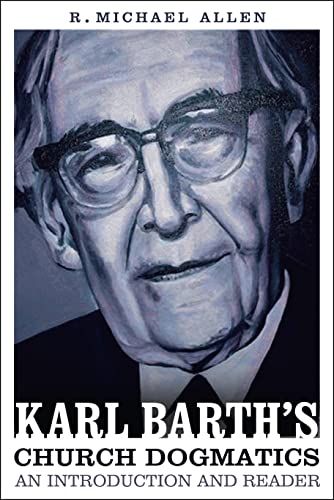
Karl Barth’s Church Dogmatics (henceforth CD) is intimidating. The CD is massive. Even the method Barth scholars use to refer to its sub-volumes is challenging to the uninitiated. Beginners cannot simply be wished good luck and told to wade into CD I.1—not if they’re going to ‘get’ what Barth is about at least. As a result the study of Barth’s CD has in North America mostly been limited to professionals or students taking advanced theology degrees. R. Michael Allen, it seems, saw an opportunity—an opportunity driven by the very practical challenge of how teachers could get students reading Barth’s work without having to choose one part-volume of the shelf-filling work to assign. The limited focus of the latter option is fine for advanced students, but insufficient for introducing the full scope of Barth’s thought. Allen fills the gap with Karl Barth’s Church Dogmatics.
Allen’s book is mostly what the title suggests: an “introduction and reader.” The emphasis is on “reader.” Allen’s “introduction” is limited to one thirteen-page chapter, the brief contextualization of extracts, and footnotes scattered throughout the rest of the book. But that is all for the good; the point, after all, is to get students reading Barth’s work firsthand.
After Allen’s introductory chapter the following fourteen are made up of carefully chosen extracts from the CD. Each is introduced in a couple of paragraphs and clarified in footnotes. The location of each extract within the larger work is clearly indicated with volume references and page numbers, making it fairly easy for keen students to read more widely on any given topic. Allen also provides numerous on-ramps to Barth scholarship in English—Torrance, Hunsinger, McCormack, and the rest—through bibliographic citations at the beginning of each chapter and commentary in the notes. At just under 250 pages, the book covers a lot of territory in what is by Barthian standards a slim volume.
The advantage of the volume’s brevity is that it works well as one course text used alongside others. To initiate students to the world of Barth’s thought, a companion volume such as those written by Joseph Mangina, John Webster, or John Franke would be appropriate, as would some of Barth’s essays. It is to his credit that Allen doesn’t try to duplicate the work of those who have written whole introductory texts on Barth. However, trying to grasp the sprawling breadth and interconnected style of the CD with only Allen’s reader as a guide would not be prudent.
Those who have read Barth in depth will quibble with Allen’s choices, why this or that extract is cut short or why some of Barth’s excurses are included and others excised. Some will even be annoyed that what is printed in small type in the CD is presented in regular font in this reader. Others will point to some key piece of Barth scholarship that is not mentioned at all. These sorts of responses are inevitable. What is finally the case though is that Allen’s book fills a void. It is useful in the classroom and will rightly be at the center of many revised courses on the Swiss titan of twentieth-century theology. Along with that basic provision, Allen has served those interested in Barth’s work by highlighting key elements of the secondary literature in English. He also does an admirable job setting the CD in the context of Reformed dogmatics. For Barth’s many readers from other traditions, particularly those disinclined to plow into Reformed scholasticism, this element of Allen’s work is enlightening. Allen’s interspersed commentary is less focused on elucidating ecumenical links, a gap which can perpetuate the stereotype among Reformed students that Christian theology begins and ends with that tradition. In any event, Karl Barth’s Church Dogmatics makes it less likely that straw-man opposition to Barth will continue to characterize the reception of his work among evangelicals.