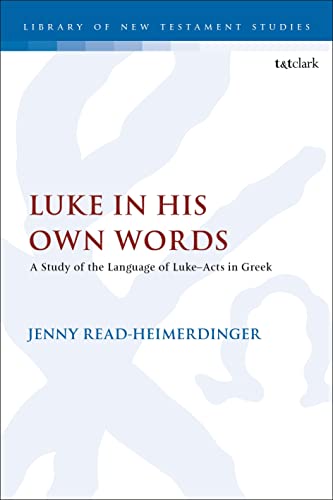
Dr Jenny Read-Heimerdinger is known for her application of discourse analysis to Luke-Acts, and particularly to the text found in Codex Bezae—her four-volume commentary on Acts in Codex Bezae with Josep Rius-Camps is an outstanding piece of detailed work in this regard. In this volume she brings together essays and chapters published elsewhere; but this is no mere ‘collected essays’ volume—Dr Read-Heimerdinger has organised and to some extent rewritten the material to form a flowing overall discussion. Her overall aim is to examine Luke’s use of Greek using the tools of discourse analysis. To do that, she eschews the use of a reconstructed critical text, such as that in the Nestlé-Aland/UBS Greek NT, and works with three major manuscripts: Codices Sinaiticus, Vaticanus, and Bezae (respectively, ℵ01, B03, and D05). The latter two are her main foci of study, with ℵ01 drawn in where it has other variants to offer. This allows her to look at the actual use of Greek by particular scribes, and she is meticulous in doing so—I am in awe of her careful, highly detailed engagement with these manuscripts, and particularly so when recognising that much of this research must have been done before searchable electronic editions of them were available.
Dr Read-Heimerdinger is one of a small but significant group of scholars who believe D05 to represent a more ancient text than that of ℵ01/B03 in Acts, and in a number of places in this book she observes where she considers the manuscript evidence of actual Greek usage to point that way. Not everyone will be persuaded by her claims, including this reviewer, but all will learn from her deep scholarship and careful observation of the evidence.
Discourse analysis focuses on language in actual use, rather than what a grammarian would consider ‘correct’ use. One of the more amusing features of C. K. Barrett’s major commentary on Acts is the way he periodically reprimands Luke for what Barrett considers his poor syntax or grammar; this is the very opposite of Dr Read-Heimerdinger’s approach. In particular, she engages with the way Luke’s Greek is organised, and her study of each discourse feature generally begins with considering that feature in the text shared by her chosen manuscripts, before turning to consider where there are variant readings affecting the feature in the different manuscripts. She adopts the widespread axiom among grammarians that choice implies meaning, i.e., that differences in usage reflect differences in meaning, rather than merely being “stylistic” in an aesthetic sense. In particular, she studies where a feature has a default usage (often, but not always, most of its uses) and there are also other usages, regarding these as (respectively) unmarked and marked uses. An author/scribe using a marked form is drawing readers’ attention to it, and she seeks to ask why in sentence after sentence. Discourse analysis also considers features which help us, as modern readers and non-native speakers of Koiné Greek, to recognise how the author is guiding us to read, including how the text is structured and organised at micro and macro levels.
The features studied are the article before proper names (ch. 2), sentence connectives (ch. 3), word order (ch. 4), expressions for the Holy Spirit (ch. 5), the tracking of participants (ch. 6), parallel terms (ch. 7), and the overall structure of Luke’s two books (ch. 8). A conclusion draws the threads together, followed by a bibliography, and a welcome Scripture index, which enables readers easily to find relevant discussions when studying particular passages in Luke-Acts. This book, then, covers quite a lot of ground, and I shall pick out some specific studies to indicate how the argument works.
Concerning the use of the article with proper names, of both people and places, that Luke regularly introduces them without an article and subsequently refers to them with an anaphoric article has long been recognised. Dr Read-Heimerdinger increases our understanding by arguing cogently that the presence of the article is Luke’s norm, and the marked use, without an article, indicates that the person or place is salient in the passage, i.e., the role they or it play is crucial.
Connectives identify division of Acts into episodes (or not). In particular, δέ and οὖν mark discontinuity, a new development or section or an aside, whereas καί marks continuity within an episode, as does τε. Dr Read-Heimerdinger notes a number of places where variant readings indicate a different perspective on the way a story, or cluster of stories, develop, rather than merely a stylistic preference of the scribe.
When it comes to the structure of Luke and Acts, Dr Read-Heimerdinger gives us a careful analysis of the use of connectives within Acts, noting which come at the beginning, middle and end of units within the text. She also highlights that ancient narrative texts do not have sharp boundaries between units; rather, overlap happens through sentences which link two units together, and which make decisions about where one unit ends and the new unit begins less straightforward (cf. Bruce Longenecker’s work on chain-link transitions in the NT, although she does not cite it). She then progressively works from larger units to smaller, putting the major division of Acts in D05 at 13:1, where the main transition from Peter to Paul takes place (the same appears to me to be true in ℵ01/B03). She argues that locations are key to the next level of subdivision, with Acts 1–5 located in Jerusalem and Judaea, and 6–12 in Samaria and other parts of Israel (I note however, that at least 6:1–8:1a; 9:26–29; 11:1–18 and the whole of 12 are set in Jerusalem), with 6:1–7 as a bridge between the two. Because of the gaps in D05, it is harder to make a clear division of Acts 13–28, but she argues for a change at 18:24 from evangelising the nations to Paul’s journey to Rome via Ephesus. Her overall chart (p. 221) then breaks these divisions down further. Much here is debatable, of course.
This is a book which requires solid competence in Greek, since much is untranslated, and persistence with detailed argument, so it’s not bedtime reading. It represents fine, careful work which is indispensable to future studies of the Greek text of Luke and Acts. It illuminates features of Luke’s writing, whatever one’s view of the relationship of the texts found in different manuscripts. Libraries will certainly want to have this on their shelves, and others will look forward to the paperback. Dr Read-Heimerdinger has put us in her debt.