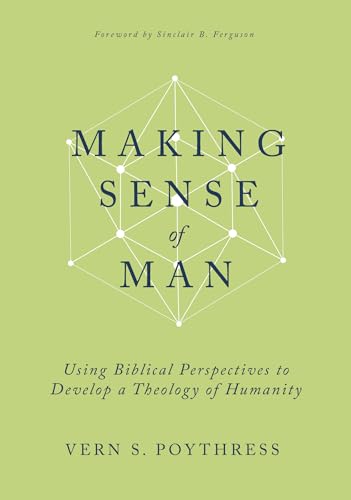
Poythress, distinguished professor of New Testament, biblical interpretation, and systematic theology at Westminster Theological Seminary and author of numerous books, has provided a clearly articulated, well-argued, and in-depth exposition of the doctrine of man from a Reformed perspective.
The book is divided into seven parts, followed by four appendices, which cover such topics as the doctrine of man in the Westminster Standards and the doctrine of man grounded in the Trinity. Part 1 (chs. 1–6) sets the stage for the remainder of the book, addressing the interpretation of Genesis 1–3, the concept of the “image of God,” and humanity’s origin and moral state before the fall. Part 2 (chs. 7–8) gives attention to interpretative and hermeneutical principles. Part 3 (chs. 9–13) burrows into some key aspect of the doctrine of man, such as the temporal nature of humanity and the prelapsarian condition of man. Part 4 (chs. 14–20) explores humanity’s composite nature, i.e., body and soul. Part 5 (chs. 21–26) focuses on the implications of God’s prelapsarian covenant with Adam. In Part 6 (chs. 27–31), Poythress expounds on human sexuality and the notion of free agency. In part 7 (chs. 32–35), the final section of the book, Poythress delves into the state of man after the fall and the nature of sin. In a book of this length, there is a tremendous amount that could be said; however, considering the limitations of space, this review will focus on some key aspects.
Though Poythress writes from an explicitly Reformed perspective, this does not imply endorsement of every Reformed writer. For instance, he takes issue with Barth’s relational understanding of the “image of God.” Barth is correct in associating the image of God with the ability of relationality, but he misses the mark by over-inflating this one aspect at the expense of others. Concerning G. C. Berkouwer, Poythress believes that his “position shows an understandable concern to stress the holistic character of man’s relation to God and the dynamic, obedient character of this relation” (p. 204). Yet, much like Barth’s error, the author sees Berkouwer as overemphasizing the dynamic perspective of the image of God, favoring only “the analogy of breaking” and restoration” (p. 205). Later, in his discussion of human freedom, Poythress takes issue with Jonathan Edwards’s formulation of freedom as deciding according to one’s “strongest motive” (p. 528). While recognizing that Edwards attempts to solve the dilemma existing between freedom and necessity by appealing to “moral causes and natural causes” (p. 537), Poythress argues it is unclear how this distinction solves the dilemma since it does not sufficiently demonstrate how causation, whether moral or physical, makes sense of human responsibility.
Poythress’s engagement with the aforementioned thinkers brings out a clear strength of this book, namely, his use of various analogies to elucidate the various topics under consideration. To begin with, following the linguist Kenneth L. Pike, he employs three different perspectives for expositing the doctrine of man: (1) “particle,” or “stable wholes,” (2) “wave,” which emphasize the dynamic aspect of humanity, and (3) “field,” that is, “a system of relations” (p. 122). Rather than prioritizing ontological, functional, or relational aspects of human nature, Poythress sees each of these as different perspectives on the same phenomenon.
Moreover, Poythress appeals to the “law of Christ” (Lex Christi) as a framework for drawing out the implications of his study. While it is not possible to reproduce this framework here, it suffices to note that Poythress builds on an analogical use of the Decalogue to understand the various topics covered within the doctrine of man. For instance, regarding the first commandment, “[y]ou shall have no other gods before me” (Exod 20:3), he notes how it points to (1) God as “supreme” (p. 142), which then leads humans to resemble God by being “supreme among earth [sic] creatures” (p. 149) and by magnifying his supremacy. United with Christ, who perfectly reflects God’s supreme power, we too share in his reign, escaping sin’s dominance. Using and applying the Lex Christi is the greatest strength of this book, given its ability to tie together and draw out the implications of our humanity in relation to God in Christ.
Poythress also cogently argues that such terms as “image of God,” “spirit,” and “soul” are best categorized as ordinary speech rather than technical and, as such, theologians fall into error by making these and other terms specialized, effectively ignoring the semantic range of their meaning. Following this, Poythress draws from the strengths of each perspective on the meaning of “image of God” without maintaining their weaknesses. Hence, he is able to offer a clear, sound defense of such doctrines as the intermediate state, the indistinguishability between spirit and soul, as well as to recognize the strengths of each explanation of original sin. To conclude, Poythress’s sound and sophisticated yet accessible treatment of the doctrine of man makes it an essential reference work for any student.