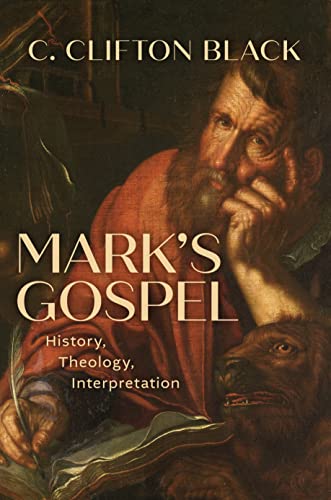

A prolific scholar on Mark’s Gospel, C. Clifton Black has assembled seventeen chapters of essays, articles, and blog posts previously published between 1988 and 2021, as well as a freshly written, thorough survey of the status quaestionis, “Markan Studies: Whence and Whither?” (pp. 134–73). After a brief, 34-page commentary on Mark’s Gospel, Black divides this book into three parts: historical studies, theological studies, and homiletical studies. Since it would be impractical to summarize each essay of this wide-ranging anthology, this review focuses on the new essay, the capstone at the end of part 1, before critically appraising its contents and summarizing the book’s overall value for different groups of potential readers.
In “Markan Studies: Whence and Whither?” Black reviews three decades of scholarly trends in studying Mark and offers suggestions as to where the study of Mark may go from here. Black identifies three areas of study that have proven especially fruitful: the investigation of Mark’s genre, the application of memory studies to Mark’s portrayal of Jesus, and the examination of Mark’s relationship to the Roman empire. Black acknowledges that since the publication of Richard Burridge’s What Are the Gospels? A Comparison with Graeco-Roman Biography (Cambridge: Cambridge University Press, 1992), a scholarly consensus has emerged that Mark and the other canonical Gospels are examples of ancient biographies, but he avers that Mark also has affinities with other types of Hellenistic Jewish and Greco-Roman literature, and he warns his fellow scholars against having “a taxonomical fixation that diverts as much as it directs” (p. 141). Black similarly registers qualified agreement with those scholars who situate Mark within its Roman imperial context. By contrast, he is more skeptical of recent scholarship that affirms the historical reliability of Mark based on memory studies. To Black, the tendency of scholars who apply memory studies to Mark and the other Gospels to conflate the historical Jesus with the Christ of faith is “misguided” (p. 150).
Regarding the future of Markan studies, Black offers six suggested avenues of study. First, scholars may study the Greek style of Mark in light of recent developments in rhetorical criticism. Second, while some scholars have studied how the OT functions in Mark, no one has yet answered the question “whether Mark comprises a jumble of OT sources and themes or possesses a scriptural cohesion” (p. 166). Third, Mark’s accounts of Jesus’s miracles deserve closer scrutiny. Fourth, scholars may attempt to elucidate the relationship between Mark and other NT texts—though Black personally doubts how persuasive these arguments may prove. Fifth, the reception history of Mark from the second century through the Protestant Reformation needs to be unearthed. Finally, Black foresees various cultural lenses, such as “race, ethnicity, gender, sex, class, and the power dynamics that emerge—sometimes, erupt—at their intersection,” to be prevalent features of Markan interpretation within the foreseeable future (p. 170).
Black’s stance in relation to this last trend raises what for many conservative evangelical readers will be an unwelcome aspect of tis book: its occasional denials of biblical inerrancy and more frequent use of critical methodologies that focus on exposing oppressive power dynamics at work within the text and its contexts of interpretation. As a senior professor at Princeton Theological Seminary and an ordained minister in the United Methodist Church, he (unsurprisingly) directs his homiletical remarks in chapters 16–17 not only to qualified men but also to women. Perhaps more surprisingly, he briefly uses profanity in the transcript of his own homily (p. 425).
These reservations aside, this collection of essays is a welcome addition to Black’s lengthy list of publications on the Gospel of Mark. The status quaestionis essay alone justifies the price of this book for Markan scholars. In addition, the inclusion of numerous chapters from otherwise hard-to-access, expensive edited volumes and the revision of at least three of the included essays make this a volume worthwhile of the consideration of NT scholars more broadly (see the acknowledgements on pp. 427–29). Pastors, too, will find numerous chapters helpful to them as they prepare to preach or teach Mark. The introduction consists of Black’s 34-page, accessibly written commentary on Mark. Chapters 7, 8, and 10 contain theological reflections on Mark that are particularly relevant for pastoral ministry (pp. 177–210, 229–45). Finally, chapter 16 contains numerous blog posts on various passages in Mark that Black originally wrote for workingpreacher.org and which provide homiletical examples to other preachers (pp. 371–420). Mark’s Gospel: History, Theology, Interpretation offers something for everyone working either in the academy or in the church.
Jordan Atkinson pastors Friendship Baptist Church in Harveysburg, Ohio, and is a PhD student at Midwestern Baptist Theological Seminary in Kansas City, Missouri.
David Bentley Hart’s book entitled That All Shall Be Saved is a powerful argument at first glance for the doctrine of Christian universalism, which is the view that those in hell all eventually enter heaven. However, upon a closer examination, it will be seen to…
While Christians should understand and practice forgiveness, many of them have not experienced forgiveness from others within the church. This situation leaves the church vulnerable to the schemes of Satan. After a brief introduction to the rampant problem of unforgiveness, this article stakes out prevention…
In response to the erosion of the biblical paradigm of gender and marriage in modern Western society, some believers are inclined to support any promotion of heterosexual monogamous marriage as a positive moral force. However, this impulse can be dangerous, as certain conservative ideologies, while…
Throughout his writings, but especially in the presentation of his ecclesiology, John Gill exhibits a steadfast commitment to a theological sensibility today referred to as Baptist catholicity. Gill’s ecclesiological writings are thoroughly catholic in their method and content, as evidenced by a robust engagement with…
How does the author of Hebrews understand Psalm 8? It is a question scholars and other careful readers continue to ask. A lot of the discussion turns on whether Hebrews thinks Psalm 8 applies to Jesus alone or to Jesus and other humans. An equally…