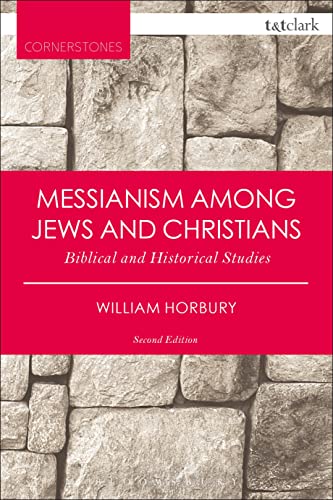
This volume provides revised/updated versions of essays originally published 1981–98, together with a helpful introduction to major issues in recent/current scholarly analysis of ancient Jewish messianism. All these discussions are typically characterised by an astonishing breadth of familiarity with primary sources and with the scholarly debate, elegantly crafted argumentation (usually), and a generosity of spirit toward those with whom Horbury disagrees. For anyone concerned with Jewish messianism in the second temple period and possible ramifications/—relevance for earliest Christian confession of Jesus as Messiah, this will be essential reading. Within the limits of this review, I can only give a basic indication of what awaits the reader, and indulge in a couple of expressions of dissent.
The essays are grouped under several broad foci. For the Second Temple Period, there are studies on ‘Messianism in the Old Testament Apocrypha and Pseudepigrapha’ (arguing that messianism has a bigger place than granted by some recently), ‘The Gifts of God in Ezekiel the Tragedian’, and ‘Herod’s Temple and “Herod’s Days” ’ (proposing that Herod the Great’s temple project reflects ancient ruler-cult ambitions, and that Jews may have celebrated a Herodian festival in his honour long after his death).
This is followed by essays on the NT. In ‘The Messianic Associations of “the Son of Man” ’ Horbury maintains that Daniel 7:13 was interpreted messianically and that, although there was no ‘son of man concept’ such as rejected by Vermes and others, the expression ‘son of man’ was in a less direct sense ‘a messianic title’ (the latter claim less persuasive in my view). ‘The Twelve and the Phyliarchs’ presents the honorific status/treatment of the sons of Jacob in ancient Jewish tradition. In ‘Jerusalem in Pre-Pauline and Pauline Hope’ Horbury reviews ancient Jewish expressions of hope for an eschatologically renewed/rebuilt Jerusalem, suggesting that Paul adapts and reflects such a hope in Romans 11:26. On the basis of a detailed survey of Jewish traditions in ‘The Aaronic Priesthood in the Epistle to the Hebrews’ Horbury judges that Hebrews’ treatment of priests and cultic matters is more compatible with a Palestinian provenance and a date before the First Revolt than recognised by many scholars. In ‘Septuagintal and New Testament Conceptions of the Church’, he illustrates the verbal and conceptual indebtedness of the NT to the LXX in the way the elect are portrayed.
The third section comprises essays on Synagogue and Church in the Roman Empire. ‘Messianism among Jews and Christians in the Second Century’ is a defence of the view that early Christian claims about disputations over the proper identity of the Messiah between Jews and Christians probably do reflect realities, and that messianism was more of a feature of second-century Judaism than sometimes recognised. In ‘Suffering and Messianism in Yose ben Jose’, Horbury studies poems of a synagogue ‘Precentor’ from sometime in late Antiquity, focusing on Yose’s treatment of suffering and his messianic ideas. Horbury’s main emphasis seems to be that Yose’s poems illustrate the limitations of the Mishnah as reflection of the themes and concerns of ancient Judaism. (Horbury hints that the idea of a suffering Messiah is not so strange as most think, but this seems to me ill-advised.) ‘Antichrist among Jews and Christians’ is a defence of Bousset’s judgement that the Antichrist concept may well derive from pre-Christian Jewish traditions of eschatological opposition to God’s redemptive purposes. Finally, ‘The Cult of Christ and the Cult of the Saints’ presents Horbury’s case that pre-Christian Jewish veneration of martyrs and ‘saints’ may have ‘constituted a factor in the rise of the cult of Christ’.
The wealth of learning offered here makes it seem churlish to complain about anything. But I mention one brief further objection here, about Horbury’s efforts to derive cultic devotion to Jesus from pre-Christian Jewish tradition. The problem is that Horbury defines ‘cult’ so vaguely (and unhelpfully) that it includes any kind of respect or reverence, and then treats all expressions and forms of respect/reverence as if they basically amount to the same thing and/or explain one another. In this, he ignores the very real Jewish (and Christian) concerns about differentiating God from other beings, especially in the kind of reverence given, and the remarkable difference from contemporary Jewish practice constituted by the pattern of devotion given to Jesus in earliest Christianity.