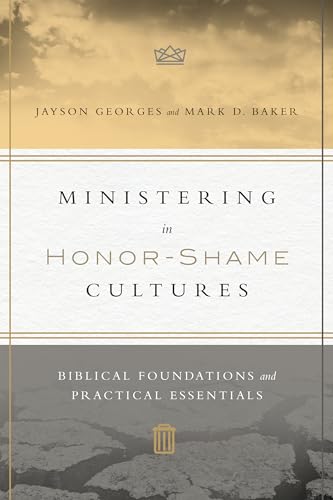
A surge of books and articles have appeared in recent years concerning honor and shame. Some are technical, others simply give broad overviews. All the while, readers ask, “How should honor-shame shape our ministry?” Well, I bring good news. Jayson Georges and Mark Baker have written the book so many people have been looking for. In Ministering in Honor-Shame Cultures, they serve a wide range of readers by explaining the meaning and relevance of honor-shame across diverse cultures. Not only are their insights both personal and practical, they also demonstrate a biblical and theologically sound approach to the topic.
Ministering in Honor-Shame Cultures has three main parts: cultural anthropology, biblical theology, and practical ministry. The last section makes up about half of the book. The opening three chapters provide an excellent introduction to the subject of honor-shame. They show how honor-shame is a human dynamic, not merely an Eastern phenomenon. The discussion draws widely from history, anthropology, personal experience and current events.
Georges and Baker rightly distinguish shame and guilt yet without forging a false dichotomy between the two concepts. They acknowledge the importance of both ideas. Using multiple illustrations, readers see why honor and shame are important considerations for making moral decision. Each has “objective and subjective dimensions” (p. 69). Furthermore, whereas shame concerns identity (“who I am”), guilt involves a person’s actions (“what I do”).
In Part Two, the authors’ study of the Bible both corroborates and develops the prior discussion. Readers will be glad to see Georges and Baker’s opening affirmation, “Ultimately the story of the Bible is about God’s honor and God’s face, not just ours” (p. 67). Accordingly, while sin can be understood in terms of guilt, many texts show that “shame is a theological problem, not just a psychological abnormality” since “we bear shame in the eyes of people and God” (p. 69). Four points summarize the relationship between sin and shame: (1) sin dishonors God, (2) sin makes us objectively shameful before God, (3) sin leaves us feeling ashamed, and (4) shame induces sin (p. 73). In short, “sin is an illegitimate claim to honor that dishonors God and shames ourselves” (p. 110).
Naturally, other doctrines, such as salvation, are understood via an honor-shame perspective. They suggest that “removing shame requires more than forgiveness. . . . So overcoming shame needs a sort of remaking or transformation of the self” (p. 38). They also overview a shame-to-honor motif, which “structures the worldview narrative of Israel as a nation [and] continues into the New Testament” (p. 82). Readers will see numerous biblical passages that demonstrate what becomes of those who do not humble themselves before God. Borrowing a line from C. S. Lewis, the book says all will see the Father “either conferring glory inexpressible or inflicting shame that can never be cured or disguised” (p. 88).
dquo;Justification is not simply being declared not guilty, but God’s declaration that we belong within his community” (p. 112).
Part Three discusses a number of practical issues yet without succumbing to pragmatism. It focuses on spirituality, relationships, evangelism, conversion, ethics, and community. Space doesn’t allow for an overview of each chapter. It suffices to say that many examples and stories within this final section not only clarify the meaning of honor-shame, they also demonstrate how honor-shame can shape the church’s ministry.
Despite the exceptional insights contained throughout the book, some readers will no doubt have objections. As with any work, people will disagree with particular interpretations or nuances given to this or that verse. Others will want more from the book. However, no one will complain for a lack of substance. Rather, I suspect readers will desire to learn more about the subject. Georges and Baker did not intend to write an exhaustive treatment of honor-shame and ministry. One should not criticize Ministering in Honor-Shame Cultures for what it does not attempt to do. Thankfully, they anticipate questions people might have. Therefore, they provide three appendices that equip readers to reflect further on biblical passages and resources related to honor and shame.
I heartily commend Ministering in Honor-Shame Cultures because it truly advances the conversation about honor and shame in ways that are practical and accessible for everyone in the church. This is not merely a book for missionaries but also for theologians, pastors and lay Christians. After all, the authors show that honor and shame transcend particular cultures; fundamentally, they are biblical issues.