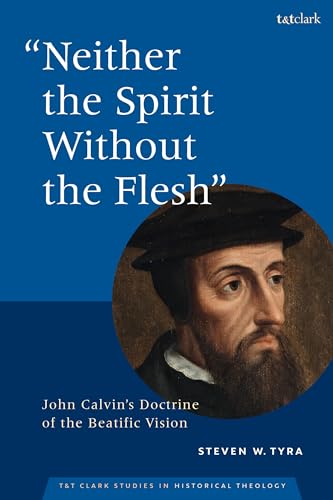
Steven Tyra enters the debates surrounding the beatific vision with a thoughtful, readable, and well-researched volume that seeks to articulate John Calvin’s (1509–1564) controversial position. Such controversy has outlived the Reformer and is visible in Hans Boersma’s Seeing God: The Beatific Vision in Christian Tradition (Grand Rapids: Eerdmans, 2018). Tyra argues that Boersma understands Calvin’s contribution to the doctrine as ‘minimal at best’ (p. 7). He then sets out to correct this perceived misstep with careful scholarship to demonstrate the weight with which Calvin considered this topic alongside the polemical battle from both within and without the Reformed camp.
The central issues that Tyra seeks to engage within Calvin’s thought are (1) whether the body is necessary for the beatific vision and (2) when the faithful will glimpse the visio Dei. In chapters 2–3, Tyra sets in place the divergence between East and West concerning the state of souls and the beatific vision. He argues that the West parted ways from the Eastern church by teaching that the visio Dei was experienced immediately upon death—without the need for a resurrection body. With the establishment of purgatory as a distinct location between heaven and hell, the West’s understanding that the beatific vision would be enjoyed only by those who had been spiritually cleansed prevailed. Following such “purgations” in purgatory, the idea that there would be a further wait for the cleansed was unconscionable to the Medieval Latin West. Cardinal Bellarmine (1542–1621) had accused Calvin of expressing “Greek” ideas. Tyra exhibits the validity of this accusation. He highlights Calvin’s indebtedness to Irenaeus and other Greek Fathers, such as John Chrysostom, alongside the later Medieval Bernard of Clairvaux.
In chapter 4, Tyra places Calvin in his theological context by displaying how he stands apart from both the radical Reformers and Rome. By examining the evolution of Calvin’s thought from Psychopannychia (1542), his commentaries, and the Institutes, Tyra discerns a refinement in Calvin’s doctrine. Tyra displays that Calvin contended that the soul reached new heights in the interim period. There, the faithful would enjoy God, but their rest and enjoyment would remain incomplete. The souls travelled or journeyed on pilgrimage to their final goal—the visio Dei. “It was simply the happiness of a child hearing the knock when her father has been a long time away—an expectant happiness, fired by the hope of a still greater encounter to come” (p. 81). Throughout his monograph Tyra reminds the reader that Calvin saw the interim state as a continuation of the earthly pilgrimage of the saint. Believers would await the day of their final resurrection and, in their bodies, receive the sight of God.
Tyra’s great contribution is given in the fifth chapter. He advances the convincing idea of an intra-reformed debate between Calvin and Peter Martyr Vermigli (1499–1562). Tyra contends that Vermigli’s explanation of 1 Corinthians 13:12 is directed towards Calvin. Vermigli, as a Thomist, contended for a clear vision of God by the soul upon death. For Vermigli, heaven without the sight of God would be no heaven at all. Here, Tyra notes Calvin’s great disagreement with the Thomists concerning material creation in heaven. Human “bodies were no bar to beatitude; they were in fact its prerequisite” (p. 135).
Towards the end of the volume, Tyra engages with Jürgen Moltmann’s assertion in The Crucified God that Calvin believed Christ’s humanity would cease. This proves to be a pivotal argument as Tyra uses Calvin’s comments on the transfiguration to suggest that in the interim state the faithful would see God in the face of Christ. When the resurrection occurs, then the veil will be removed. This would not be a removal of Christ’s flesh but of humanity’s inability to see God as he is. Christ’s body would continue as the prototype to which all saintly flesh is conformed, “the nourishing root of their resurrected lives” (p. 153).
At the end of the monograph, Tyra handles the immediate reception of Calvin’s teaching after his death. Having so carefully constructed Calvin’s sources and polemical context, it was disappointing not to have more information presented in this area. Tyra establishes briefly that Theodore Beza (1519–1605) and Nicholas des Gallars (c. 1520–1581) did not praise Calvin’s doctrine. But then he moves quickly from the sixteenth to the twenty-first century. The volume would have benefitted from describing how the subsequent generations defined the beatific vision in relation to Calvin. There is mention of John Owen (1618–1683), but he is considered all too briefly in the context of modern debates.
Tyra’s work is a considered approach to Calvin’s doctrine of the beatific vision. It is an excellent piece of scholarship that engages thoughtfully with the primary sources. This work is ideal for scholars and students, but Tyra’s writing style ensures that it is an easily accessible volume. He has approached Calvin’s doctrine on its own terms, not merely as an anomaly or something to simply pass over. He has been careful to place Calvin as one who was wedded to the meaning of the biblical text and who attempted to faithfully appropriate the historic teaching of the Church. His desire is to show that a strictly Calvinist understanding of the beatific vision is to declare that God is beheld by faithful souls in their resurrected bodies (pp. 170, 173).