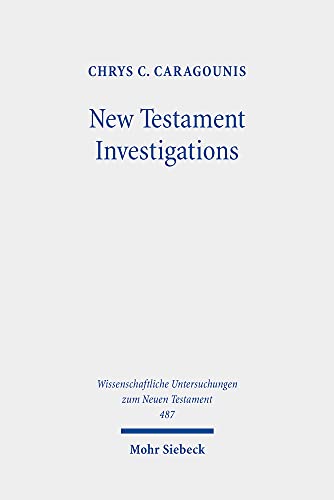
With this collection of essays, Chrys Caragounis, professor emeritus of biblical studies at Lund University in Sweden, has offered the reader serious investigations into “exegetical problems in the synoptics, in John, and especially in Paul” (p. viii).
The first, introductory chapter discusses his diachronic approach to Greek. He argues, in departure from such scholars as Friedrich Blass, that there is significant continuity between “Modern Hellenic,” which he dates from AD 600 to present day, and “Ancient Hellenic” (p. 7). To support this, he states that “54.71%” of Homeric words have been preserved in Neo-Hellenic Greek and, even more strikingly, he asserts that “92.78% of the vocabulary of the New Testament is either spoken or understood in Neohellenic” (p. 15). With John 15:1–6 as a test case, drawing from such works as Aesop’s Fables, he argues that by the middle of the third century BC ἄμπελος carried the sense of “vineyard” rather than “vine” and thus the sense of John 15:2 is that Jesus is the vineyard and believers are vines in the vineyard.
The remainder of the book is divided into four parts. The first part (chapters 2–5) discusses linguistic issues. The second part (chapters 6–7) gives attention to background studies. The third part (chapters 8–10) explores Johannine writings and, finally, the fourth and longest part discusses Paul’s writings.
A few highlights ought to give the reader a sense of Caragounis’s contributions. Inquiring into the meaning of Ἑταῖρε, ἐφʼ ὃ πάρει in Matthew 26:50, Caragounis argues that ἑταῖρος does not connote friendliness but is rather “a mere word of address” (p. 54). Thus, one could reader this sentence as “Friend, [keep yourself] to the point” (p. 54), i.e., Jesus is telling Judas to get on with betraying him. Caragounis makes the case—drawing from the medical vocabulary used by Luke in Luke 14:2 and Acts 3:2–8 and astronomical words used in Matthew 24:29 and Mark 13:24 when paraphrasing the LXX—that the worldview current in New Testament times and assumed by New Testament authors was the Hellenic worldview. In addition, the author pushes against the use of the term “Greco-Roman” since it fails to recognize the differences that exist between Hellenic and Latin authors and their respective cultures.
Fascinatingly, the author argues that the background for John 1:1 is not Jewish but rather Stoic and Heraclitean and thus λόγος designates not “word” but “a Divine Person” (p. 120); as such, John 1:1–13 would garner the agreement and the ear of John’s intended audience—the Stoics and Heracliteans of Ephesus—giving them opportunity to hear the gospel (cf. John 1:14). He provides a thorough analysis and critique of social science approaches to the setting of Corinth. Here, he pushes against reconstructions that “the Corinthian Church’s situation reflected the Roman stratification as well as the Roman patron-client institution” and “consisted of a very small group of believers” (p. 196), arguing instead that the Corinthian church was large and belonging to all strata of society except “the highest level” (p. 195). Caragounis, then, gives us his perspective on the vexing question of the New Perspective on Paul. He argues that both Sanders and Dunn have missed the mark since the former “has not given a reliable picture of the many-faceted Judaism” and the latter has “mistranslated and misinterpreted the Hellenic text of Gal 2:15–16” (p. 226).
There are a number of reasons to commend this book. To begin with, Caragounis’s arguments for a diachronic approach to the Greek language are a significant contribution to scholarship. Though not all may agree that the Greek language has been relatively stable from its beginnings to the present, the evidence that Caragounis offers at the very least invites further exploration into this question. Additionally, he pushes against an overreliance on Jewish approaches to the New Testament. Clearly, the New Testament, as written mainly by Jewish authors, does draw from Jewish thinking, but Caragounis reminds us that this ought not obscure the fact that Hellenism also exerted culture pressures on the thought-world of NT authors. Lastly, the essays are stimulating, well researched and well argued.
Two weaknesses must be mentioned as well. First, while Caragounis’s critique of the New Perspective on Paul is welcomed, one wishes he had dialogued with post-New Perspective exegetes such as John M. G. Barclay to provide a more well-rounded assessment of current scholarship. Second, in the penultimate chapter of the book he argues that Paul did not teach the resurrection of the body in 1 Corinthians 15; rather, Paul presented the immortality of the soul in Jewish garb. However, this fails to account for the logic of Paul’s argument, which connects the resurrection of believers with the bodily resurrection of Jesus (cf. 1 Cor 15:1–20). Also, his reading of 1 Corinthians 15 does not agree with other Pauline texts on the resurrection such as Romans 8:18–24 and it renders unintelligible Paul’s discussion of the resurrection and the responses of his audience, as recounted by Luke in Acts 17:22–32 and 23:1–11. Caragounis, then, appears to have allowed the pendulum to swing too widely with an overreliance on Hellenistic sources.
Despite the aforementioned weaknesses, this is a truly a remarkable book. By putting his decades of study into these essays, Caragounis, a senior NT scholar, has demonstrated the need for returning to Hellenistic sources contemporaneous with the NT, reminded the reader of the need to reevaluate trends in linguistics, sociology, and history, and stimulated further avenues of exegetical exploration. Due to the technical nature of his discussions and the use of (often) untranslated texts of Greek, this book will be most useful for a serious student of the New Testament or NT scholar.