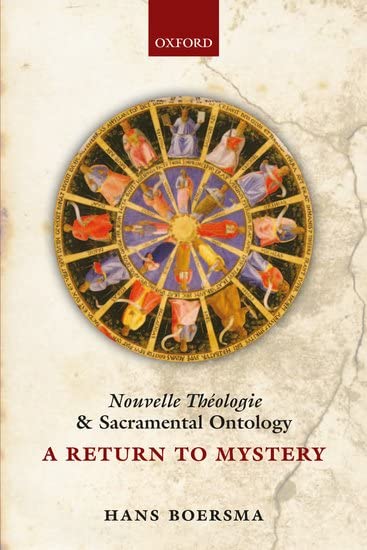
The author’s subject is a group of twentieth-century Roman Catholic theologians who challenged the hegemony of neo-Thomism and sought to rejuvenate theology by returning to Scripture and the Fathers—de Lubac, Bouillard, von Balthasar, Chenu, Daniélou, and Congar. It explains mainly how they sought to connect nature and the supernatural by adumbrating a comprehensive sacramental ontology centred on mystery. They did not constitute a defined school nor agree on everything among themselves, but they struck out in the same direction and against the same currents: ‘The sacramental ontology of nouvelle théologie did … make for a relatively cohesive, shared sensibility’ (p. 83).
Before discussing their work, Hans Boersma surveys the precursors to this ontology in the shape of Möhler, Blondel, Maréchal, and Rousselot. Then we move on to the Jesuits, de Lubac and Bouillard, and the Dominicans, Balthasar, and Chenu, contrasting what is nonetheless their theologically related attempts to draw the natural and supernatural closer together. But it is with the hermeneutical retrieval of the Fathers and their spiritual interpretation of Scripture effected by de Lubac and Daniélou that ‘we find ourselves … at the heart of the sacramental ontology which motivated many of the endeavours of this French renewal movement’ (p. 149). The hermeneutic involved here can itself be called ‘sacramental,’ probing and disclosing the deep dimensions of reality contained in the events narrated in Scripture. Boersma is not content to give us a purely descriptive account. In his introductory chapter on ‘the rupture between theology and life,’ he had indicated that he was positively interested in the ecumenical potential of the movement under discussion. So where the spiritual interpretation of Scripture is concerned, ‘we also find ourselves at the place where genuine theological rapprochement between Catholicism and Protestantism should originate’ (p. 149). This point is taken up again in the ‘Conclusion’ on ‘The Future of Ressourcement’ (the return to Scripture and the Fathers), which follows two substantial chapters on Daniélou, Congar, and de Lubac on doctrine and tradition, church, and sacrament. Thus the volume ends with this statement: ‘The re-appropriation of a sacramental ontology may provide a mindset that will open up avenues for a common return to mystery’ (p. 294).
The author is to be warmly congratulated on a book that is both thoroughly researched and pleasingly written, an exercise in good, solid, purposeful scholarship, which sustains the reader’s interest. If critics be found who will dissent from the way that Boersma picks out the unifying strand of sacramental ontology in his authors, it is hard to imagine that any will be found who will credibly deny the suggestiveness and plausibility of much in the main lines of exposition. It is a measure of the confidence that Boersma inspires in the reader that one would want to hear the author on subjects which are outside the scope of his concerns, such as how we should plot the relation of transcendental Thomists (especially Rahner, himself influenced by Maréchal, for example) to the nouvelle theologians’ constructive criticism of neo-Thomists.
Let me flag up two questions. The first concerns the relation of the nouvelle théologie to Augustinianism. Augustine features occasionally in this book, as does Neoplatonism, whose contrast to Aristotelianism is occasionally germane to the exposition. Boersma remarks on Chenu’s attitude towards Augustine, but it is worth supplementing these remarks by recalling Chenu’s comment in a study which remains useful, Towards Understanding St. Thomas: ‘All reforms in the course of the Church’s history, it has been said, were stirred up and supported through the influence of Augustine.’ Arguably, it is a point Chenu makes a tad non-committally, but he is certainly not hostile towards that claim. Given (a) the influence of Augustine on Protestantism and (b) Boersma’s interest in ecumenical possibilities, not to mention (c) the strong affinity that the present Pope has with Augustine, it would have been interesting to know in more detail how Augustine fared in the theology of the thinkers under scrutiny. (If this is to request another volume from the author, I make no apology.)
The second question is even more directly focussed on ecumenical possibilities. Because Boersma’s immediate task is overwhelmingly an expository one, his theological advocacy of the nouvelle theologians on this point or that, including on the core issues of sacramental ontology and spiritual interpretation of Scripture, is usually indirect and implicit rather than blatant and explicit. Of course, where we think theological rapprochement between Catholics and Protestants should originate depends on how we interpret their disagreement. But supposing, for the sake of argument, we find the moves proposed in this volume theologically promising or agreeable. Still, just how far will consensus get us? Ecclesial realities are often at a vast, vast distance from what is disclosed in theological insight. My question is designed neither to criticize the author nor to doubt the importance of getting straight on the theological issues which he discusses, whether or not we are in complete accord with the nouvelle theologians or their present historian. It is just a matter of musing yet again on the fact that producing good theology is a small, though vital, part of the battle. How that theology can contribute in practice to the task of bringing life to the Church remains the nagging question. But it is not the author’s business to address this question in specific detail; meanwhile, we are most certainly edified by the path of reflection ably described and furthered in this volume.