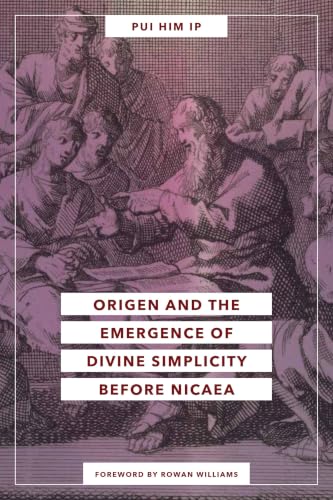
Pui Him Ip, director of tutorial programmes at the Faraday Institute for Science and Religion, affiliated lecturer at the Faculty of Divinity, and research associate at St Edmund’s College, has, with this substantial revision of his doctoral dissertation, offered us an intriguing exploration of the doctrine of divine simplicity before Nicaea.
Ip states that the intention of this book is to retrieve “the intelligibility of divine simplicity by tracing the doctrine’s historical emergence and developments before Nicaea” (p. 1) in the face of modern contention that simplicity is in conflict with the Trinity ad intra and ad extra. This is based on the author’s conviction that the “ante-Nicene sources” are both “distinctive and illuminating” (p. 1).
In the introduction, Ip sets up the body of the book with two notable observations about the modern reception of divine simplicity: (1) it is oversimplified since it does not give adequate account of the Platonic background to the doctrine in the patristic period, and (2) it fails to attend to the “ante-Nicene polemical contexts” (p. 6), especially the concern with Monarchianism. Thus for Ip, “doctrinal history” (p. 7) will shed the light necessary to substantiate the doctrine of divine simplicity against modern detractors.
The introduction is followed by seven chapters. The first two chapters develop an account of the philosophical background of simplicity. In the first chapter, Ip focuses on Plato’s Republic, especially sections 380d through 383c, concluding that this passage is a “locus classicus” (p. 25) of divine simplicity. In the second chapter, he gives attention to two thinkers in the Middle Platonic period, namely, “the Middle Platonist Alcinous (c. mid–second century CE) and the Jewish philosopher Philo of Alexandria (c. 20–15 BCE to 45–50 CE)” (p. 30), arguing that these thinkers coherently “synthesize the simple deity and the simple first principle” (p. 30).
The third chapter gives attention to Irenaeus’s use of divine simplicity in his opposition to Valentinian theology. The fourth chapter surveys the concerns surrounding the “Monarchian controversy” or, rather, “controversies” (p. 70), which prepares the way for Ip’s discussion of the contours of Origen’s thought in light of the two polemical contexts of Valentinianism and Monarchianism in the three remaining chapters. Ip ends the book with an epilogue discussing possible historiographical implications of his study.
This is simply a stunning work. To begin with, by focusing on Plato’s Republic and what is, according to Ip, the first occurrence of divine simplicity, Ip demonstrates that it was employed “as a second-order rule of speech” (p. 25) to protect divine immutability and truthfulness, thus bridging the metaphysical and ethical implications of simplicity, namely, that the divine does not change and “is true in word and deed” (p. 24). Middle Platonism further develops this use of simplicity by identifying “God as the highest first principle” (p. 34) and, as such, the source of all forms, effectively requiring God, as the source of goodness, beauty, etc., to be simple and without parts. Some consequences of Ip’s findings at this juncture are that the pre-Christian origin of simplicity and its later reception and development points to a nuanced use of divine simplicity, which safeguards key Christian understandings of God such as his immutability, truthfulness, and aseity. Ip’s findings also remove the charge that simplicity is but a piece of theological obfuscation beholden to Aristotelian categories and in conflict with orthodox Trinitarian theology. In turn, it pushes against the reduction of simplicity to metaphysical categories solely: for God to be true, he must be metaphysically simple.
These consequences are substantiated by his discussion of Irenaeus and Origen in light of their distinct contexts and concerns. Here, Ip sees these two theologians as addressing the larger “ante-Nicene Trinitarian problematic” (p. 49). Ip compellingly argues that, for Irenaeus, simplicity protects the unity of God with his attributes, thus pushing against the Valentinian concept of generation that would posit the divine attributes as emissions and thus separated from the Father. Upon turning to Monarchianism, Ip makes clear that, in the ante-Nicene context, a third way was needed to avoid the two errors of unduly separating the Father from the Son, following Valentinian implications, and completely identifying the Son with the Father, as with Monarchianism. Ip persuasively argues, then, that simplicity established the grammar for Origen to avoid falling into either ditch.
As is clear from Ip’s historical exposition, not only was divine simplicity understood to protect attributes that are integral to God, but it also, by combating two errors in the ante-Nicene context which undermined proto-Trinitarian formulations, effectively proved complementary to later orthodox developments regarding the Trinity, contra modern detractors. Beyond this, as Ip himself rightfully suggests, his return to an ante-Nicene context demonstrates the historical viability of returning to earlier periods in order to understand the developments in doctrine rather than merely interjecting later orthodoxy into earlier formulations. Moreover, with his nuanced reading of Origen, Ip effectively rehabilitates Origen as a proto-Trinitarian thinker, albeit not one who has fully worked out an orthodox position. Finally, with his genealogical approach to divine simplicity in the ante-Nicene period, he demonstrates the significant connection that was made between ethical and metaphysical aspects of divine simplicity.
In sum, this is a very competent, well-argued work on historical theology that significantly moves the discussion forward regarding the teaching on divine simplicity in the patristic period and ought to be consulted by any serious student of this period.