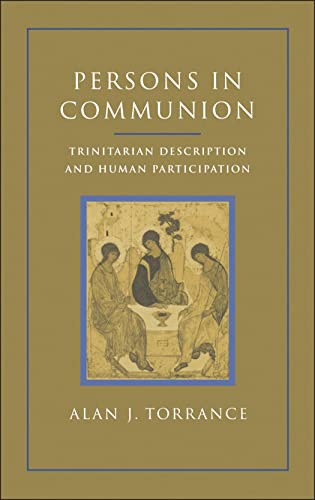
Work on trinitarian description is now the trend of the day, and Alan Torrance here provides us with a detailed and demanding study of a multitude of aspects of theology which relate to this subject. In essence the book examines three themes: theological description, and how language is used of God; the models used in theological description and systemization; and the appropriateness of using the term ‘person’ for the three members of the Godhead. As well as being a treatise on religious language, theological models and the Trinity, the work doubles as an important study on the theology of Barth, as it is against the backdrop of Barth’s theology that Torrance’s study progresses. The likes of Zizoulas, Rahner, Jüngel and Moltmann are also brought into the discussion.
Torrance is extremely successful in drawing out the particularities and nuances of Barth’s approach to theology in general. Several themes run throughout the book, especially Barth’s insistence that we do not come to any theological task with an a priori agenda in mind. All theology, and all understanding of the Trinity, can only come after the Christ-event. Ironically, Torrance’s careful study demonstrates how Barth himself may have been guilty of this failing in his use of the term Seinsweise instead of person to describe the members of the Trinity. Torrance contends that one of the benefits of the term ‘person’ is that it brings with it a model of divine action which is more healthy than the model with which Barth worked. That is, Barth’s fundamental principle was of revelation, whereas Torrance sees the model of communion, rather than mere communication, as much more demonstrative of the inner-relationships between the three persons in the Trinity. This conclusion builds upon an extremely insightful argument concerning the propriety of Aquinas’s theology of analogy, which Torrance places at the centre of his study.
In such a comprehensive work, the conclusions and implications are extremely broad-ranging. Especially appealing is Torrance’s argument that in the Christ-event our language is taken up, transformed, even ‘commandeered’ by God, and thus given a dynamic which enables terms (such as ‘person’) to be used meaningfully of the members of the Trinity. In addition, Torrance’s contention that theology be done doxologically is something to be welcomed by all evangelicals—as long as the content of the revelation is never lost sight of. Another helpful feature of the work is the way in which Torrance brings in witnesses from other contemporary discussions, and the fact that amidst the flow of discussion he continually points out the relevance to other contemporary theological debates (feminist theology, and the divide between East and West, to give two examples).
Torrance’s ability to bring so many strands of theology together must be admired. For those new to the areas under discussion, and for anyone seeking an introduction to the Trinity, they would be advised to look elsewhere. But for those wanting to struggle and wrestle, there is much to be learned and applied from considering the nature of ‘Persons in Communion’, and this work comes highly recommended.