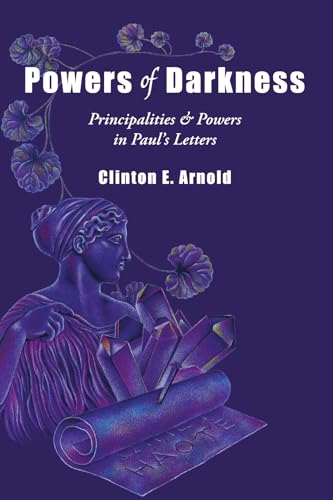
Anyone judging this book by its cover might be forgiven for supposing that this was yet another addition to the flood of books fuelling contemporary evangelical fascination with the New Age movement. But they would be wrong. In fact, the New Age movement receives only a handful of passing references. Instead the author, a NT scholar, having previously completed a doctoral thesis at Aberdeen on the concept of power in Ephesians, has set out to present us with a semi-popular account of what the NT actually teaches about the principalities and powers.
This volume is divided into three major parts dealing, in turn, with ‘First-century belief in the powers’, ‘Paul’s teaching on the powers’, and ‘Interpreting the powers for today’. Part I tackles such issues as magic and divination; astrology; and popular beliefs about the supernatural amongst Jesus’ near contemporaries. Although the section claims to focus on the first century ad it actually covers a period of at least 400 years. In spite of the difficulties involved in attempting such a task in so little space, I think he succeeds in presenting a fair picture of the popular beliefs regarding supernatural powers in that era. Having thus set the scene, the section concludes with a summary account of Jesus’ teaching and practice in relation to the demonic.
The heart of the book is a popular presentation of Pauline teaching on the powers. Arnold approaches the material thematically with chapters on the nature of the powers; Christ’s defeat of the powers on the cross; the implications of Christ’s victory for believers; the continuing impact of the powers upon the lives of believers; the exclusivity of faith in Christ; the nature of spiritual warfare; and the eschatological subjection of the powers. There is much food for thought in these chapters, particularly the parts about the continuing impact of the powers and the nature of spiritual warfare. However, I did become uneasy at times about his references to divine power being imparted to or appropriated by believers. God does not plug us into some spiritual battery charger! He gives himself to us in the person of the Holy Spirit: person, not power—the difference is tremendously important.
That uneasiness increased as I read the final part of the book. This is easily the least satisfactory part. It begins with an attack on the mythological interpretation of the powers. Here Arnold draws a sharp (and questionable) contrast between myth and reality. Perhaps he should re-read C.S. Lewis’s essay ‘Myth Became Fact’! However, the low point of this chapter is his misunderstanding of Carl Jung. Arnold is simply wrong to suggest that Jung denied the reality of the ‘powers’. The fact that Jung located them in the psyche does not mean that he saw them as merely psychological or subjective. On the contrary, for Jung, the psyche was a largely uncharted spiritual realm, every bit as real as the material world. My point is not that Jung was right, far from it, but rather that when we criticize others we should be sure that our criticisms hit the mark.
The same point applies to Arnold’s treatment of Walter Wink since his case against Wink rests upon the latter’s appropriation of Jung. Wink’s apparent approval of the activities of Findhorn (a New Age community) suggests that we should approach him with caution. But, given the weakness of its foundations, I wonder how helpful Arnold’s critique will be.
Another worrying aspect is the approval Arnold gives to the work of Frank Peretti. His novels are certainly popular amongst evangelicals but this does not make their view of prayer orthodox! This relates to my uneasiness with Part II, since Peretti favours the language of spiritual power over that of personal relationships.
My uneasiness with this emphasis on power highlights the chief weakness of the book. A responsible theological account would qualify the language of power with the language of persons. This would lead to a more cautious use of the term ‘personal’ in relation to demons. Possessed of will and intelligence? Yes, certainly. But capable of personal relationships? C.S. Lewis, whom Arnold seems to admire, knew better. The powers know only power relationships. More generally, it manages to present biblical teaching on the powers in remarkable isolation from other theological emphases. Thus it falls short in the theological effort of relating what is said in the NT to the lives of believers.
In spite of this criticism, I think this is a useful book. It provides us with a helpful account of what the NT (and particularly Paul) has to say about principalities and powers.