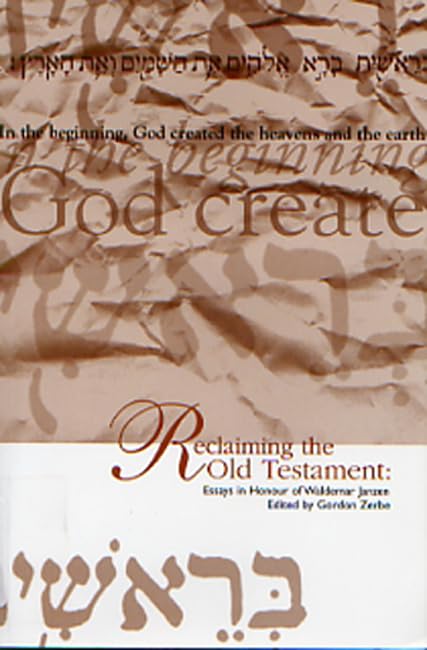
This volume is a collection of essays in honour of long-time professor, scholar and dean at the Canadian Mennonite Bible College in Winnipeg. In an opening tribute, Gerbrandt highlights the breadth and depth of Janzen’s life as ‘Formative Professor, Distinguished Biblical Scholar, Direction-Setting Dean and Mentor to Students’. Hopefully this will capture the imagination of young biblical scholars embarking on careers in the confessional academy.
Janzen himself is allowed to set the tone through the republication of his essay: ‘A Canonical Rethinking of the Anabaptist-Mennonite New Testament Orientation’. Here he confronts the prevailing indifference to the OT within his own tradition and, drawing on the insights of canonical criticism (Childs, Sanders), calls it to embrace it as scripture. The rest of the book traces the impact of Janzen’s passion on the Mennonite tradition, as former students, colleagues and friends present 16 articles on various OT-related topics.
In the first section, many superb articles address foundational hermeneutical and ecclesiological issues with attention to the relationship between the OT and homiletics, systematic theology, biblical theology and methodology. Of these, readers will be most familiar with the work of Elmer Martens. He provides an excellent review of the history of biblical theology, revealing the trend towards embracing both testaments, and calls for a rethinking of three crucial issues. First we need to rethink the idea that the OT-NT relationship is the problem, since the Bible could be divided as easily into three sections (including creation to Abraham) as two. Secondly, we must rethink the concept of progressive revelation, which reflects modernist progress models, and adopt instead the concept of cumulative revelation, in which the OT remains valid. Thirdly, we should rethink our methodological options, and embrace techniques from intertextuality. These proposals truly contribute to the vision of both Janzen and this Festschrift, and provide a hermeneutical foundation for ‘reclaiming the Old Testament’.
The second and larger section consists of various essays on particular OT themes and passages. These touch on issues both valued and controversial within the Mennonite tradition: worship (Doerksen), literary and feminist studies (Reimer), imprecation (Harder), missions (Guenther), true and false prophecy (Epp-Tiessen), political advocacy (Weaver), farm economics (Daught), Jubilee (Ollenburger), forgiveness and reconciliation (Zerbe). Especially noticeable here is the consistent link between biblical text and Christian ethics. This must delight Janzen, who himself wrote Old Testament Ethics: A Paradigmatic Approach (1994).
The final four essays mine the OT for theological stones to form a solid foundation for Christian ethics. Weaver draws on the commission of Moses as a foundation for current political advocacy, reminding us that wherever ‘we find ourselves engaged in God’s work of setting people free from oppression, that is where we will find God’ (197). Daught leads us through various royal texts (Judges, Samuel, Kings) as well as the Joseph novella to confront modern ‘gods of productivity and efficiency’ in our global economy (206). Ollenburger treats Pentateuchal legislation on the year of Jubilee as a powerful metaphor, reminding us of ‘God’s passion to free people from all kinds of enslavement’ (234). Finally, Zerbe reveals the striking similarity between the two testaments on the theme of forgiveness, before summarising core values for forgiveness today.
While some may find a volume on Canadian Mennonite interpretation of the OT less than enticing, this volume grants biblical scholars a unique perspective. Here they can observe various hermeneutical struggles and opportunities within the controlled environment of a particular tradition, and hopefully find much needed encouragement to persevere in scholarly OT study within confessional contexts.