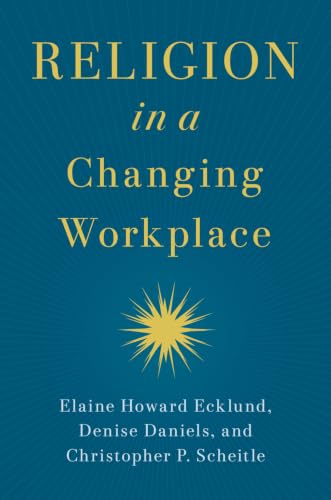
The authors of Religion in a Changing Workplace began their research in 2018 and practically stated, “Our years of research on this topic led us to conclude that shutting out religion from the workplace is not only impractical, if not impossible, but also not the best way forward” (p. 148). Ecklund, Daniels, and Scheitle are social scientists who write about a “new way of looking at religion in the US workplace … considering not only how individual but also group characteristics and differences have an impact on expression of faith in the workplace” (p. 2). Their book aims to “foster healthy workplaces, healthy workers, and healthy religious tolerance and pluralism” (p. 2). In effect, they advocate for religion to be part of the workplace Diversity, Equity, and Inclusion (DEI) conversation. Given the admirable scope of this book, which includes all faiths—including the non-religious—it is relevant for both secular and faith-based audiences. While Christians are likely to find their perspective(s) expressed in this work and will be interested in reading about the experiences of other faiths, the book is relevant to all leaders interested in why and how to include religion in the workplace.
Across ten chapters, the authors contend that “faith can be expressed at work in ways that benefit both employees and organizations” (p. 7); explore “how workers use faith to find meaning, purpose, and calling in their work” (p. 7); spotlight experiences with discrimination; and lay out strategies organizations can employ “to support religious expression while protecting and honoring the identities of both religious and non-religious workers” (p. 8). Each chapter (except the first) ends with “The Bottom Line”—a beneficial summary reinforcing key ideas. Scholars will appreciate the breadth and depth of familiar references from Marx (p. 72) to Wuthnow (p. 57) to Keller (p. 31), while likely encountering new sources as well.
The book consists of findings from a primary survey conducted in 2018, supplemented by another survey in 2021, investigating the impact of the pandemic on relationships at work. Both surveys yielded over 15,000 responses and 300 follow-up interviews. Since Christianity remains the most dominant religion in the United States (p. 4), most interviews were conducted with Christians, but Muslims, Jews, and non-religious adherents were also included. These interviews aimed to be “a representative distribution of gender and race and ethnicity” (p. 156).
One unique contribution was the introduction of four approaches (conceptualized as quadrants) related to how work is experienced as a calling based on the type of purpose (intrinsic or extrinsic) and location of the audience the work serves (proximal or distal) (pp. 43–49). At the individual level, this conceptualization allows the reader to reflect on and self-assess their own experience(s) of finding meaning in their work because the quadrants are not mutually exclusive. Taking a broader approach, churches and small groups could consider forums to discuss self-assessments, in addition to reading this volume for overall context—not just for their specific faith, but to understand the experience(s) of those of other faiths.
As a Christian who has worked in for-profit organizations in Canada for over twenty-five years with teammates across the United States (and globally), I found the guidance the authors provided to workplace leaders (pp. 109–11) to be relevant and practical—such as making religious discrimination reporting procedures clear. On the other hand, their advice is not necessarily equally applicable to all sizes of organizations, because asking employees in large corporations what celebrations they want to see may not be feasible.
The book concludes with additional recommendations for organizational leaders to navigate “potential downsides” related to religion at work (pp. 149–52), which are also relevant for individuals and faith communities. Each recommendation challenges organizations to reconsider the role of religion in the workplace, and I cannot help but wonder if rethinking the role of religion is not the clarion call for workplace inclusion. This book certainly makes that case.
Overall, I wanted to see more discussion around the impact of workplace dynamics between co-workers, teams, managers, and workplace culture on the experience of expressing faith at work. Perhaps this discussion would also have surfaced more examples of participant experiences related to discrimination due to the “salience of a person’s religious identity” (pp. 98–99) and other factors like gender, race, age, and education level (p. 99–100). I also wanted more inspiration. Verbatims such as Ben’s (p. 47) were a bonus in this volume because they reinforced the authors’ points and inspired the reader to find ways to do likewise. Interestingly, even those verbatims that were not uplifting encouraged me (and I hope other readers) to consider my own experiences at work and what action(s) I can take.
In short, this book complements volumes like Timothy Keller’s Every Good Endeavor (New York: Penguin, 2012). It contributes meaningfully to the “faith-friendly” tenet central to the faith at work movement as popularized by David Miller’s volume, God at Work: The History and Promise of the Faith at Work Movement (Oxford: Oxford University Press, 2007). It also extends the conversation to challenge DEI efforts in practical, actionable ways that readers can promote within their organizations. While it may be quixotic to expect religion to be part of the workplace DEI conversation, it is perhaps even more unrealistic to exclude religion from the workplace altogether.