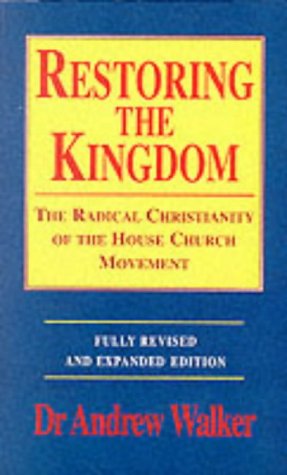

This important new book is the fruit of research carried out by Dr Walker for a BBC Documentary on the house church movement. The book is a very readable yet serious study of the origins and significance of the movement. Dr Walker raises many major questions about the theology and practice of the movement; yet his prologue reveals him to be a sympathetic observer, deeply impressed by its radical Christianity.
The casual observer is aware of great diversity within the house church phenomenon, and Dr Walker helps clarify different groupings (classified for the purposes of his book as Restoration 1: R1, and Restoration 2: R2).
Part 1 gives a detailed study of the rise of the house church movement from the mid-1960s until 1985; we are introduced to key figures, enabled to explore the links with the house church movement in America, observe the influence of men like Ortiz and Watchman Nee, and understand the division between Restoration 1 and 2 in 1976 and their respective development since. This part is carefully researched, enabling the reader to plot historical developments, with valuable footnotes for further research. My main criticism is that the wealth of detail sometimes obscures the overall pattern.
Part 2 examines the distinctive teaching and lifestyle of the movement, and reflects sociologically on its status as a denomination or sect. There are two excellent chapters tracing the origins of the movement from within Brethrenism, the Catholic Apostolic Church (descended from Edward Irving), and the mainline Pentecostal denominations. The complex relationship between the Restoration movement and the broader charismatic renewal is also explored. Dr Walker includes a fair examination of four charges commonly brought against the house church movement.
The book raises in passing a range of theological issues especially focused in the restoration movement: Baptism—is infant baptism valid? Are Christians so baptised to be encouraged to be rebaptised by immersion as an issue of obedience? Conversion and its relationship to the gift of the Holy Spirit and spiritual gifts. Legalism and perfectionism—issues involved in the split of Restoration 1 and 2 in 1976. Discipling—does this reflect NT teaching and practice, or is it open to serious abuse? Is Restorationism in danger of identifying kingdom and church too closely? How do the contemporary and first-century church relate? What is the character of that first-century church?
The house church movement’s reading of church history and the NT is in danger of being simplistic. They see the church soon plummeting from the NT ideal, reaching an all-time low ebb at the end of the sixth century. The Reformation is seen as the dawn of a new era, with some recovering true baptism. The twentieth-century witnesses the recovery of spiritual gifts and apostolic ministries, so that the glory of the NT church is being restored. This is God’s work through a fresh outpouring of his Spirit, preparing his church for his Son’s return. It seems foolhardy in this way to ignore 2,000 years of church history. Such a view also fails to recognize diversity and development even within the life of the NT church concerning church order. The search for the perfect, pure church has fascinated different groups again and again within church history, but has been met by failure and disillusionment.
Dr Walker helps us explore critically many of the theological issues raised by the teaching of the Restoration movement; at the same time he helps us recognize within the movement a clear work of God, challenging the complacency and half-heartedness of the established churches, calling them to a rediscovery of spiritual life to meet the challenges and opportunities of the present time. This is an important book, enabling the reader to think through one of the most significant church movements of recent times.
Wycliffe Hall, Oxford