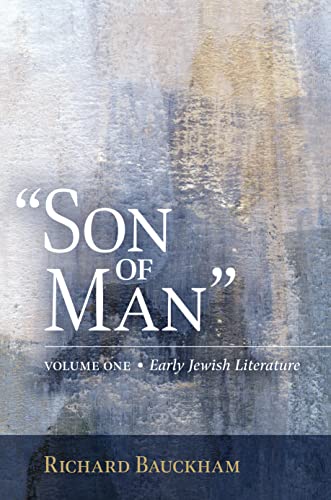
Richard Bauckham, professor emeritus at St Andrews and well-known New Testament scholar, offers the reader the first volume of a two-volume work exploring the significance of the phrase “Son of Man.” In this first volume, he explores early Jewish literature pertaining to the phrase in question.
In the introduction, Bauckham notes the connections commonly drawn by scholars between the use of the phrase “son of man” in the Gospels and its use in Dan 7:13 and the Parables of Enoch. Given that “a few of the sayings of Jesus undoubtedly allude to [Dan 7:13],” and “in the whole of Second Temple Jewish literature the phrase ‘son of man’ is used with reference to a messianic figure only in [the Parables of Enoch]” (p. 2), it is apropos for Bauckham to focus on the Parables of Enoch (part 1) and the Jewish reception of Daniel 7 in the Second Temple Period (part 2).
Bauckham addresses introductory matters surrounding the Parables of Enoch (hereafter, Parables) in the first section of part 1. Some highlights from the trenchant discussions in part 1 and 2 will give the reader a sense of Bauckham’s work. The Parables are part of larger collection of books written in Ethiopic and translated from Greek with a possible Aramaic or Hebrew origin known in English scholarship as “Ethiopic Enoch or 1 Enoch” (p. 7). Bauckham makes the case that, of the books contained in 1 Enoch, the Parables have the closest connection to “the Book of Watchers,” which he sees as “a new version” (p. 14) of this earlier work.
The second section of part 1 addresses the role of the “Son of Man” in the Parables. Here, Bauckham retracts his earlier position that the Parables represent an exception in early Jewish literature by portraying the Son of Man as receiving the same worship that God receives. Additionally, Bauckham sees this volume as answering Fletcher-Louis’s challenge for New Testament scholars to engage more thoroughly with “the findings of the Enoch Seminar” (p. 25). Turning to the content of the Parables, he argues, based on the grammar of the Parables, that the phrase “Son of Man” is not a title but rather equivalent in meaning to “‘man’ or ‘human’” (p. 35).
Later, in section three (part 1), he makes the case that the Parables present the messianic figure as judging “the kings and mighty” (p. 68) on an earthly throne that is distinct from the heavenly throne from which God judges. Regarding the question of the preexistence of the messianic figure, Bauckham argues that there is not a hint of something beyond a human origin for the figure. Rather, the figure is identified as Enoch. In summary, based on his reading of the Parables, the “Son of Man” (= man) is thoroughly human and thus any appearance of worship is merely “obeisance … before a person of superior status” (p. 111).
With the second part, Bauckham’s goal is not to offer an exegesis of Daniel 7, since this “could too easily prejudice the study of later Jewish interpretations of the text,” which would also fail to recognize the ways in which “ancient interpreters… diverge considerably from the approach of modern scholars” (p. 135). Here, Bauckham gives attention to such ancient interpretations as the Greek versions of Daniel 7 (§2.2), 4QAramaic Apocalypse (a.k.a., 4Q246; §2.3), 4 Ezra (§2.5), as well as the absence of Daniel 7 in the works of Josephus (a.k.a., 4Q246; §2.10).
Some of the interpretations of Daniel 7 in this literary corpus that are surveyed within this section include: (1) connecting the figure of Dan 7:13–14 with “the leader of the people in the new exodus” (p. 187, 4Q246); (2) seeing “the future Davidic king” as “the key actor (besides God)” (p. 191) in the eschatological scenario of 4Q246; (3) joining the Messiah with Enoch and Elijah as exalted to heaven while being thoroughly human and later performing an “eschatological role” (p. 253; 4 Ezra); and, distinct from these views, the return of David himself (not a descendant) as the Messiah (p. 319; Rabbi Aqiva).
Bauckham’s study in part 2 can be summarized thus: the “Son of Man” in the majority of Jewish interpretation of Daniel 7 was thoroughly human, though dwelling in heaven only to return to execute his messianic role, usually in connection with the “Davidic hope” (p. 374). Strikingly, based on his findings, he writes, “It is hard to believe that anyone in late Second Temple times could have recognized the phrase ‘Son of Man’ as an allusion to Daniel 7:13” (p. 374).
To conclude, a short review simply cannot do justice to this book. Bauckham offers a penetrating exploration of early Jewish literature pertaining to the “Son of Man” phrase that furthers our understanding both of Jewish messianism and the Parables of Enoch. One minor stylistic quibble can be mentioned: why, in such a large work, did he divide it into sections rather than chapters? While one can anticipate some ways that he will apply his findings to the Gospels, this reader is very much interested in seeing what insights we will find from Bauckham’s pen in volume 2 and in what ways he will challenge and refine earlier scholarship on the phrase in question.