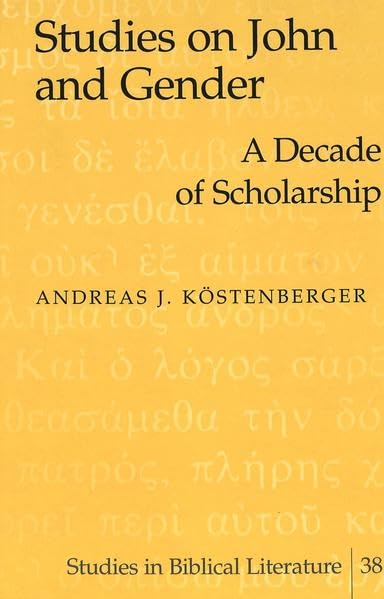

The author of this book is Professor of New Testament at Southeastern Baptist Seminary in North Carolina. The title suggested to me a review of recent scholarship on women in (or feminist approaches to) the Fourth Gospel. In fact it is a collection of the author’s previously written essays, all but one already published elsewhere, divided into two parts, ‘Studies on John’ and ‘Studies on Gender’.
‘Introduction to John’s Gospel’ forms a concise, evangelical overview of historical background, literary features and theological emphases. ‘Early Doubts of the Apostolic Authorship of the Fourth Gospel in the History of Modern Biblical Criticism’ demonstrates how the shift from believing in, to rejecting the son of Zebedee as author depended on a change of presuppositions rather than on any new evidence. ‘A Comparison of the Pericopae of Jesus’ Anointing’ applies verbal aspect theory to the various Synoptic accounts to show how John focuses more on Judas’ treachery; Mark and Matthew, on Jesus’ instruction for disciples. ‘Jesus as Rabbi in the Fourth Gospel’ stresses the centrality of this title over against perspectives that emphasise solely John’s ‘high Christology’. ‘The Seventh Johannine Sign’ argues that the temple cleansing, not the walking on water or resurrection or miraculous fish-catch, completes John’s perfect number of events that publicly reveal God’s glory in Christ and are explicitly called signs. ‘The “Greater Works” of the Believer According to John 14:12’ points to the fundamental superiority of the new age, not the extensive nature of the worldwide mission, as the better deeds Jesus predicted his followers would perform. ‘The Two Johannine Verbs for Sending’ shows that pempo and apostello function synonymously for John. ‘The Challenge of a Systematized Biblical Theology of Mission’ applies insights from the Fourth Gospel to dispute ‘incarnational’ mission as a viable category.
The first two chapters in Part II refute Roman Catholic claims of apostolic origins for priestly celibacy and of ‘the mystery’ in Ephesians 5:32 as support for marriage as a sacrament (musterion here points forward to ‘Christ and the church’). The remaining five chapters illustrate various hermeneutical fallacies employed in the literature (mostly on the egalitarian side) on gender roles in the NT, sum up the author’s exegesis of 1 Timothy 2:9–15 (women are prohibited from being permanent pastor-teachers or elders), and then buttress that exegesis with more in depth analysis of certain specifics: the structure of 2:12 (‘neither infinitive a nor infinitive b’) implies that the two activities are either both positive or both negative (in this case, both positive); 2:15 refers to the general need for women to adopt traditional domestic roles (as over against the Ephesian heresy); and an actual survey of what women do or don’t do in Acts and the Pauline letters shows them in numerous important roles save that of pastor-teacher or elder).
The only essay I find essentially unconvincing is the one on signs—surely the miraculous nature of the undisputed six is a more significant criterion than any of Köstenberger’s. The author’s interest in John grows out of his doctoral dissertation under Don Carson at Trinity, Deerfield; his essays in this area will in general be less controversial though no less significant. I would modify his complementarian exegesis with respect to gender roles so that Paul is only restricting women from the single office of overseer-elder. But what is most remarkable of all about this volume is that a young scholar, only eight years removed from the completion of his Ph.D., should already be reprinting a collection of recently published articles, and that in a series so little-known and so expensive that it will not substantially broaden the circulation of his views.
Craig L. Blomberg
Denver Seminary
Denver, Colorado, USA