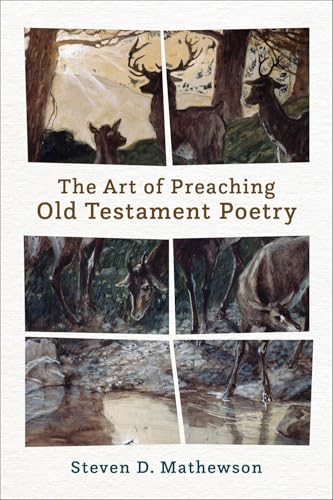
This volume is the second installment in a series of books Mathewson has published to help readers learn how to preach Old Testament texts. His first book, The Art of Preaching Old Testament Narrative (Grand Rapids: Baker Academic, 2021) offers interpretive guidance and preaching strategies for dealing with narrative passages. This volume turns to poetic books in the Old Testament and consists of an introduction, seven main chapters, and seven appendices containing sample sermons on Old Testament poetic texts. Each of the main chapters dealing with a poetic book concludes with a list of essential resources for further study.
The introduction begins by acknowledging the difficulties with interpreting and preaching poetic texts due to their highly emotive nature. Mathewson provides help in two ways: first, by bringing together the best of the scholarly works to bear on the interpretation of the passages, and second, by offering preaching strategies that are “faithful to the text and to the listeners (who may or may not have a taste for the kind of literature found in these books)” (p. 4).
Chapter 1, “Preparing to Preach Old Testament Poetry,” addresses the basics of preaching, on the one hand, and the basic elements of poetry, on the other. Mathewson identifies eight characteristics of effective expository sermons: accurate, clear, compelling, relevant, collaborative, spirit-empowered, revelatory, and redemptive. When working together, these elements convey the meaning of the text and relate it to the listeners. He proceeds to discuss the three main elements of Hebrew poetry: terseness, parallelism, and imagery. He offers examples of different types of parallelisms and figures of speech to help his readers appreciate the beauty and depth of Hebrew poetry.
Chapter 2, “Preaching Psalms,” begins by describing various types of psalms and examining their emotional trajectories, as well as analyzing the structural unity of the Psalter across its five books. The author then presents two strategies for engaging listeners: 1) using poetic flair by painting word pictures or reading a psalm with feeling, and 2) guiding listeners through the flow of thought in a psalm, using Psalms 46 and 121 as examples. He offers ideas for preaching a sermon series on the book of Psalms, especially during Christmas and Lent/Easter as “opportune seasons” (p. 59). Mathewson suggests reading the Psalms “in anticipation of Christ” as a prayer to Jesus, a prayer of Jesus, or “how Jesus fulfills description of God in the psalms” (p. 60).
Chapter 3, “Preaching Proverbs,” opens by examining the structure of the book of Proverbs. Mathewson outlines two major divisions: 1) Proverbs 1–9 articulate the superiority of wisdom over folly, and 2) Proverbs 10–31 provide examples of what it means to live guided by wisdom. He then addresses several interpretive concerns. He avers that proverbs do not offer promises but rather situational advice, as in the case of the seemingly contradictory advice in Proverbs 26:4–5. Any proverbial advice should be interpreted through the lens of God’s love, as in the case of physical discipline. Furthermore, he argues that Proverbs 31 should be read as an example of wisdom for both men and women. Mathewson’s preaching strategies include intentional, in-depth personal study of the book, supplemented by reading commentaries. He organizes sermon series topically and thematically and includes excerpts from his own sermons. He believes that preaching Proverbs should point to Christ as the culmination of wisdom (p. 93).
Chapter 4, “Preaching Job,” begins with a brief commentary on the structure and content of the book of Job, paying attention to the main characters, their dialogues with each other and God, the importance of wisdom, and the lessons that suffering and grief teach a believer. Mathewson argues that preaching Job should start with preaching Jesus in Job, as the answer to all suffering is found in Christ (p. 109). He then outlines his idea of “an ideal sermon series” on Job, a series he previously preached.
Chapter 5, “Preaching Ecclesiastes,” opens with a concise overview of Ecclesiastes, discussing its structure and various perspectives to understand its message. It moves then to discuss key words and concepts in Ecclesiastes, e.g., “vapor,” “gain,” and “under the sun” (p. 131). Mathewson’s preaching strategies include sermon series based on different ways of breaking the book into smaller portions and focusing on key texts. He also shares examples from his own outlines and sermon excerpts. When addressing the issue of preaching Christ in Ecclesiastes, Mathewson argues that true happiness is found in Jesus and serving him is “not an empty pursuit” (p. 140).
Chapter 6, “Preaching Song of Songs,” begins with a brief commentary on the role of Solomon, the structure and literary strategy of the book, and its purpose. Mathewson cautions against oversexualizing the words of the love song when interpreting the metaphors. He locates the presence of God in “flashes of fire” (Song 8:6) as an expression of committed physical love between a husband and a wife. The author’s preaching strategies include reading the entire text together with some critical resources, and he includes an outline of a single sermon along with several theological insights from its message. When addressing the issue of preaching Christ in the Song of Solomon, Mathewson argues that “we can utilize various lines from Song of Songs and either direct them to or refer them to Christ” (p. 166).
Chapter 7, “A Final Word,” encourages readers to become familiar with the poetic books of the Old Testament and get comfortable with preaching them on a regular basis. The author believes that these books provide answers, offer guidance, and bring hope to faithful followers of God.
This volume provides a helpful introduction to the riches of the Old Testament poetic books by explaining the basics of the poetic genre and offering ways of reading each book as a cohesive whole rather than a collection of verses. The book also provides practical advice on the crafting and delivery of sermons based on these hard-to-preach books. However, one is left wondering why Mathewson finds it necessary to preach Christ in each of these books. While Jesus is clear about coming to fulfill the law (Matt 5:17), he is also clear that the Law and the Prophets are sufficient in presenting the complete message of God’s love and truth (Luke 16:29–31). It would have greatly benefited this volume, and present-day Christians, if Mathewson had also offered interpretive strategies of reading and embodying the truths of Old Testament poetry on its own terms. Nevertheless, this book is a helpful addition to those striving to preach the entire counsel of Scripture.