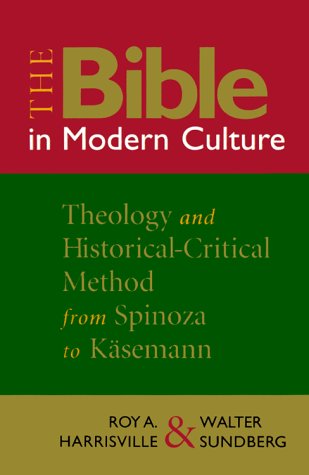

Colleagues in the Luther Seminary of St Paul, Minnesota, this team of NT and church history professors has authored a delightfully readable and informative survey of key Contributors to the rise of modern biblical criticism. Interspersing brief references to other key figures along the way, they highlight Spinoza, Reimarus, Schleiermacher, Strauss, Baur, von Hoffman, Troeltsch, Machen, Bultmann and Käsemann. Each chapter includes a bit of biography, a focus on one defining theological work of the author at hand, and an assessment of his contribution. The book’s introduction and conclusion set up and evaluate the ‘war’ between Enlightenment and Augustinian world-views throughout this period. Much as Schweitzer showed how 19th-century liberal lives of Christ consistently refashioned Jesus in the image of the world-views they represented, Harrisville and Sundberg demonstrate how none of the characters they analyse was able to transcend the issues and historical contexts of his day. Modern people, including Christians, cannot escape the influences of either the Enlightenment or the community of faith, but much confusion about the rightful role of each is dispelled in this meaty study. Ultimately, ‘rigorous, scientific examination of the Bible can neither destroy nor support faith’ (p. 272), but ‘insofar as historical-critical method brings us before this central truth of Christian existence, it is not the enemy of the church, but its austere teacher, even its friend’ (p. 273).
Craig L. Blomberg
Denver Seminary
Denver, Colorado, USA