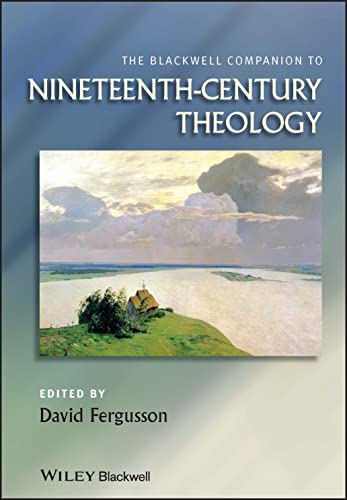
Further expanding the range of “companion” volumes, Blackwell provides a detailed glimpse across the spectrum of nineteenth-century thought. Colin Gunton originally conceived and directed this project, and David Fergusson has continued it. Like other volumes in this vast series, the goal is to introduce upper-level undergraduate students, graduate students, and scholars to complex topics while advancing discussion of those topics. Therefore, they attempt to provide material suitable for research for both beginners and more advanced readers, and they look at the culminating insights and debates in the field. This volume traces individuals, debates, and streams of thought through the nineteenth-century, an era unraveling the problems bequeathed from the Enlightenment of the preceding century. The nineteenth century’s reaction to the Enlightenment provided the raw material for twentieth-century philosophical and theological proposals, the fruit of which provide the ideological moorings of contemporary thought.
The volume breaks down into two main sections. The first part, made up of six chapters, looks at key thinkers and their influence. The second, made up of eighteen chapters, focuses on trends and movements.
The first section introduces the thought of several figures who turned the tides of thought in their age and whose legacy is still felt today (for good or bad): Kant, Schleiermacher, Hegel, Coleridge, Kierkegaard, and Newman. Each essay briefly overviews the thinker, outlining the key contours and influence of his thought, attempting to place him and his theology within the broad movement of discourse in the nineteenth-century and highlighting his continuing role. For instance, Nicholas Adams argues that interpretive communities vying for influence have often tainted Kant’s legacy. Turning to contemporary movements against this trend, Adams suggests that there is a retrieval of Kant’s texts from what he deems “Kantian arguments”—schools of thought which have, in his mind, led to an important bifurcation between Kant and the Kantians.
The second section provides the overarching context for these key figures by focusing on trends and movements. Topics range from evangelicalism to liberal theology in Germany, from romanticism and pantheism to transcendentalism and the social gospel. Just as in the first section, these chapters provide an historic overview that grounds the topic in the ideological context in which it arose and thrived (or failed). Furthermore, they address key individuals and evaluate the impact of trends and movements. Of particular interest are the chapters on “Evangelicalism” by David W. Bebbington, “Kenotic Christology” by David R. Law, “America: Confessional Theologies” by James D. Bratt, and “America: Transcendentalism to Social Gospel” by Robert W. Jenson. David Bebbington, known for his fourfold construction of evangelical identity, continues to build on his development of evangelicalism. In this particular essay, Bebbington addresses key distinctives of evangelical theology, the influence of the enlightenment, and the integration of theology and science.
Furthermore, Bebbington focuses his attention on Romanticism and the evangelical response, seeking to highlight the influence of the former, either in appropriation or rejection, in areas of doctrine, mission and sectarian movements.
For pastors, theologians, or students unfamiliar with the key figures and movements of the nineteenth-century, this volume proves to be a valuable resource to canvass ideologies which modern theology and philosophy have set to unravel. For those new to the study of nineteenth-century theology, each chapter has a detailed bibliography of key secondary sources, and contributors consistently address the primary texts (and issues with the texts) in their exposition. The second section helpfully glimpses movements and trends which are often hard to locate in the evolution of ideas. This does not take away from the importance of the first section and the quality of essays addressing individuals and subsequent reception.