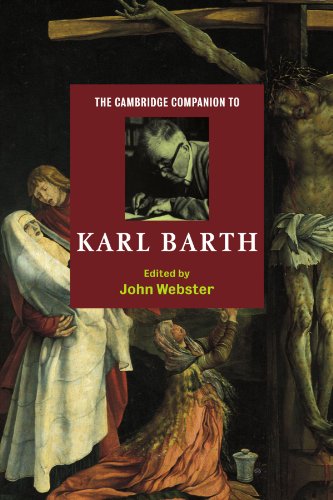
This book is not designed as an introduction to the theology of Karl Barth for the undergraduate who is commencing studies in ‘contemporary theology’. This is not to say that the book may not be of aid to such; only that this is not its purpose and is therefore not reflected in its nature. For those evangelicals who desire such an introduction, the relevant works of Berkouwer, Bromiley or Torrance would be more appropriate. This work, however, is not the product of a single mind, having eighteen chapters, each of which is written by a different author, and each of which deals with various areas or aspects of Barth’s thought. The bulk of these pertain to the specific loci of systematic theology: hence, there are chapters on such expected key topics as revelation, the Bible, the Trinity, election, creation and providence, Christology, salvation, humanity, the Holy Spirit, and the Christian community. (Eschatology does not receive a separate chapter of its own, possibly reflecting the unfinished character of Barth own writings on the subject.) There are also contributions on Barth’s thought regarding ethics, politics, pluralism, feminism and postmodernism.
The non-introductory status of this companion to Barth is revealed in three more ways. First, each chapter is fairly complex and dense, and assumes some prior knowledge of at least the language, if not the issues involved. Of course this differs in degree from chapter to chapter, but generally the point stands. Second, and with the same caveat as above, it is true to say that each author seems to be in substantial agreement with the theology of Barth. They are at times critical of certain aspects of Barth, or wanting to qualify what Barth has said in certain ways, but fundamentally, they are more than merely appreciative of the contribution Barth has made to the theological landscape. Third, the editor remarks in the Preface that the book has grown out of a very definite academic context—that of the re-appreciation which Barth’s dogmatics is enjoying in the English speaking world over the last thirty years after his death. The motif of re-evaluation in the light of half a century or so of scholarly scrutiny is very much to the fore. Hence the first chapter asks how Barth should now be read and interpreted, while the last is an autobiographical account of one prominent theologian’s ‘personal engagement’ with Barth during the course of his intellectual lifetime to date (Alasdair I. C. Heron).
This having been said, all contributions are of a good quality in that they are well written—i.e. informative, stimulating and readable—and well documented. Each chapter concludes with helpful suggestions for further reading. The general Index is also satisfactory. Recommended as an intermediate textbook for those with some basic knowledge of the subject matter and surrounding issues.