Elenctics, the field of practical theology that unmasks the true nature of world religions in light of Christianity, may well be one of the most underappreciated and underutilized tools in modern missiology. While most missionaries invariably find themselves responding to the belief systems of other religions, too often a careful theology of religions is left by the wayside. Likewise, a comprehensive evaluation of shared foundations throughout other religions is often overlooked. Yet Scripture is neither silent on the nature of man nor on the universal religious yearnings which compromise the human experience.
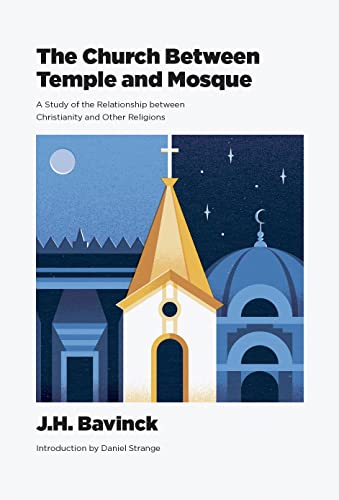
In his posthumously published work, The Church Between Temple and Mosque, J. H. Bavinck—Dutch Reformed missionary, pastor, theologian, and twentieth-century apologist—masterfully explores Christianity in confrontation of and connection with global religions. This helpful and accessible study explores and critiques a theology of religion from a Reformed worldview. In addition to the wealth of insight in the work, Daniel Strange’s introduction to the 2023 re-released edition situates Bavinck’s approach within its original context. It highlights the work as important for today through the commendation of a major scholar in the field today.
The central axle that forms Bavinck’s elenctic approach is his fundamental conception of a universal religious consciousness, introduced in Chapter 2. Though somewhat “mysterious” and not “concrete,” this concept refers to man’s common and unified experience as a limited being who grapples with basic questions of his place in the world. Bavinck argues that Scripture understands this religious consciousness as fundamentally idolatrous, revealing a suppressed substitute knowledge of God.
Like spokes connected to this axle, Bavinck evinces five perspectives or commonalities of the religious consciousness that all people and religions experience. Bavinck calls these commonalities “magnetic points” which “demand our attention and which we cannot evade. We cannot help being confronted by them” (p. 26).
Bavinck first outlines each magnetic point in turn, before returning to examine each from a biblical perspective. The first is man’s sense of a cosmic relationship and the universal experience of being connected to the universe and the world around him. Bavinck discusses this in chapters 3 and 11. The second is the universality of a religious norm and mankind’s inescapable thirst for moral rules, outlined in Chapters 4 and 12. The third is the riddle of man’s existence in light of his destiny, explored in Chapters 5 and 13. The fourth is man’s universal need for salvation or redemption, explained in Chapters 6 and 14. Lastly, Bavinck explores man’s inescapable sense that there is a supreme power, shown in Chapters 7 and 15.
Connecting the axle and spokes together across Bavinck’s writing is his unifying conceptualization for how all human religious impulses must be understood principally from God’s perspective. Bavinck most clearly explores this desire in Chapters 9 and 10. Herein, readers should expect to find not so much a philosophy of religions (although his writing is certainly theoretical) as a theology of religions, a point rightly highlighted in the introduction by Strange. Bavinck’s writing uncovers and exposes common religious conceptions about God and our existence by framing a true understanding of religious experience through the primacy of God’s view on man’s religious impulses. For Bavinck, it is not enough to consider what we see about man in response to God; instead, we must consider what God sees about man’s response to God. For example, after introducing each of his key areas of religious consciousness, he powerfully writes, “The first thing we must do now is listen. So far we have simply looked around and reflected, but now it is necessary to listen to what God says” (p. 114).
A particular strength of Bavinck’s approach is his able use of Scripture. In particular, he employs the paradigm of Romans 1 to frame the discussion of mankind’s simultaneous yearning for knowledge and repression of truth. For Bavinck, God’s self-revelation is universally evident for all humanity, as shown through the common search for God across religions. Likewise, each magnetic point in the universal religious consciousness is shown to be itself a substitution for God’s design of humankind and his revelation of himself.
Yet, this universal tendency of the human heart to simultaneously yearn for knowledge and yet repress the truth is not only applied to the religious other, but also to the church. In his final chapter, Bavinck ends with a note of humility which had already characterized the entire work. He writes,
We have seen that man has always repressed this silent work of God. In this connection we recall the two forces Paul mentions, namely, repression and substitution. They show their pernicious strength everywhere. The Church can confess this quietly and honestly, because it judges itself with this confession. It is conscious that it has often been guilty of repression and substitution in the course of its history, and it also knows that its guilt in this respect is much greater than that of the other religions, because it has so often obscured the revealed and clear gospel of Jesus Christ behind all kinds of cunning, human reasonings. In other words, the Church can say these things without any pride. (p. 194)
This insightful study, combined with an invitingly humble candor, makes Bavinck’s work a classic in the field. For theologians and practitioners alike, this work will undoubtedly be a helpful resource in meaningfully engaging the religious other. I wholeheartedly recommend The Church Between Temple and Mosque to anyone seeking to grow their understanding of the valuable discipline of elenctics. I pray that Westminster Press’s re-release of this classic volume will raise it to the attention of a new generation.