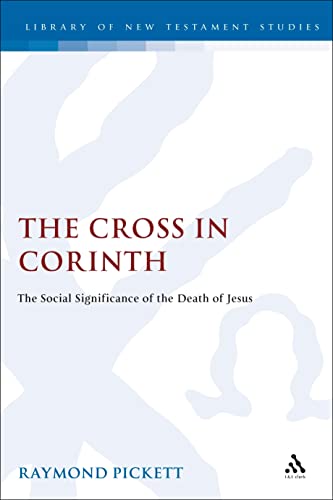
The Corinthian church had problems. These stemmed from the application of Paul’s gospel of freedom in disruptive and selfish ways. Paul has to address these while preserving the very freedom for which Christ died. In this revised Sheffield PhD thesis, Dr Pickett shows through ‘sociological exegesis’ (p. 34) how Paul achieved his purpose. First, the cross of Christ ‘deconstruct(s) those secular norms and values which are in conflict with his ideal of an egalitarian community’ and, second, ‘Christ’s death is a death for others … which symbolizes the other-regarding behaviour which he himself exemplifies and the Corinthians should imitate’ (p. 214).
In 1 Corinthians 1–4, the culturally elite consider Paul to be socially inferior in comparison with the eloquent Apollos. ‘Wisdom’ leads to arrogant superiority and conduct. But Paul wants to reform their conduct. Since they have been incorporated into the body of Christ, their lives are to reflect this. Secular status and power have a destructive effect; Paul’s own weakness provides an implicit rejection of the status system of the Corinthian elite.
The critical point in 1 Corinthians 5–14 is not the cause of the aberrant conduct but its interpersonal consequences. Paul’s converts accept his gospel. But it must have implications for behaviour. Individual behaviour which damages the body is a denial of ‘the holy People of God, a People whose existence is defined by God’s action in Christ’ (p. 92).
In 2 Corinthians 4:7–5:19, Paul shows that the fact that Christ died for all gives the motivation to live for others. Paul’s apostleship is to be judged by the same criterion, rather than ecstatic experiences (2.5:13), Israelite lineage (2.11:22) or letters of recommendation (2.3:1). Through Christ’s death, all believers become the new creation which determines Christian behaviour. This new behaviour distinguishes Paul’s ‘realized eschatology from that of his opponents, who are concerned only with manifestation of the power associated with the advent of the new age’ (p. 155).
2 Corinthians 10–13 begins with Paul’s description of his alleged inferiority. Paul is competing with his opponents for the allegiance of the Corinthians. The section is laden with rhetorical flourishes, with parody being the most prominent form of irony employed.
Initially, Pickett’s argument seems unpersuasive, partly because Pickett seems to minimise the theological significance of the cross. But by the end of the book, Pickett has made his case, illuminating not only the social significance of the death but giving it a far more comprehensive theological significance as well. Pickett shows how important the corporate notion of salvation really is. Christian behaviour in the NT is no mere add-on to the doctrine of justification by faith. Rather, Christian behaviour which challenges the power structures of our society and requires a life of ‘weakness’ is rooted and grounded in the cross of Christ. The book is also a salutary reminder to modern-day Christians who may be tempted to look for manifestation of power in outward display, that support from Paul for such a search is very slender indeed.
This is a good, even important, book. Pauline students will find it particularly important in three areas: first, the Identity of Paul’s Corinthian opponents; second, the issue of ‘spiritual gifts’; third, Paul’s apostleship. No doubt Pickett will be disappointed by the unfortunate number of typographical errors which crept into the published version but he should be well satisfied with the persuasiveness of the argument.