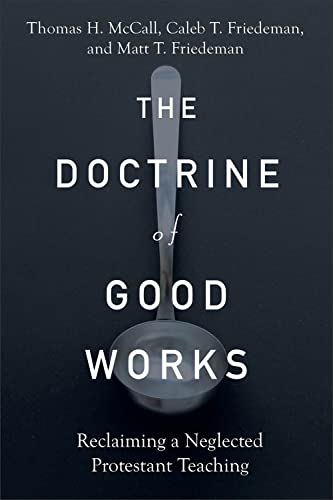
Cheap grace has led to “a crisis of credibility” for Christianity (p. xi). In response, three Wesleyan theologians bring their insights about the nature of salvation in their book, The Doctrine of Good Works: Reclaiming a Neglected Protestant Teaching. Thomas McCall is professor of Theology at Asbury Theological Seminary. Caleb Friedeman is associate professor of New Testament at Ohio Christian University. Matt Friedeman is professor of Evangelism and Discipleship at Wesley Biblical Seminary. One of the key arguments of the book is that, “We can and should conclude that good works are a means and even causes of salvation” (p. 119).
The introduction sketches the background of the credibility problem of Christians. There are pastors and evangelists teaching people that good works are not part of the Christian life, leading to people who claim to be Christians because they have prayed a prayer while exhibiting little or no effort to conform to Christlikeness. In contrast, the book’s goal is to present a vision of Christianity that “celebrates God’s gracious work on our behalf while also taking seriously the importance of genuine, faithful obedience and love” (p. xvi).
Chapter 1 presents a historical case for a broader understanding of the necessity of good works for salvation than many evangelicals in the reformed tradition affirm. The authors present voices from among Lutherans, Anglicans, and the Reformed orthodox, leading to their argument that “good works are nothing less than necessary for salvation” is a thoroughly Protestant sentiment (p. 24). The breadth of this statement, especially the inclusion of the Reformed orthodox stream of Protestantism, depends largely on Francis Turretin’s statement that good works are a necessary consequence of justification. As the authors point out, what Turretin means differs vastly from the understanding of Johann Gerhard or John Davenant. This discussion highlights the varied means the words necessary and salvation have in different strains of Protestant theology. The second chapter offers a biblical survey of passages in the Old Testament where good works on the part of believers are affirmed. Chapter 3 continues that survey with the New Testament. In the conclusion of this chapter, they propose a thought experiment where the Pauline letters are removed from Scripture. The end result, they argue, is a clear message “that good works were considered necessary [by the biblical authors], such that no Jesus-follower should expect to be saved without them” (p. 98).
The fourth chapter moves to develop an outline of a theology of good works, where they seek to set their understanding of good works, sanctification, and, more broadly, salvation within a broad Protestant tradition. This chapter is primarily about the importance of sanctification in the life of a spiritually healthy believer. Chapter 5 shifts dramatically from abstract theological arguments to case studies on churches that have made works of mercy and evangelistic outreach a central part of their mission. The focus jumps from salvation of the individual to the life of the communal church, with little consideration of ecclesiology, particularly debates about the mission of the church. The four case studies provide powerful examples of local churches blessing their surrounding communities through a wide range of programs. Chapter 6 offers nine leadership techniques to inspire deeper congregational participation in church programs. The conclusion brings the book briefly back to the theological discussion, emphasizing the importance of the doctrine of good works within Christian theology.
From the very beginning of the book, the authors critique several evangelical theologians for an improper definition of salvation. Given the references to Milliard Erickson and Michael Bird in the introduction, it seems odd that Bird is only cited in the footnotes, and Erickson makes only the briefest appearance in the body of the text. Throughout the book, there are few rebutting arguments presented against the authors’ views. While the critique of Erickson’s conflation of the terms justification and salvation may be valid, further investigation reveals that he does discuss good works in relationship to sanctification in his systematic theology. The reader would not know that from this text. Minimal discussion is given to places where Scripture itself seems to use terms related to salvation as a reference to justification. Furthermore, if we grant “error carried forward” (as the math teachers say) to Erickson’s simplification, then his consideration of good works being required for sanctification in a chapter called “The Continuation of Salvation” might dampen the accusation that Erickson’s perspective is “diametrically opposed to important strands of classical Reformed doctrine” (p. 111).
If ambiguity of terminology is to be offered as a critique, then this book will not escape unscathed. The book repeatedly critiques too simplistic a definition of salvation, but the authors are not entirely clear about what they mean by the term until near the end of the volume; they rely primarily on negative definitions of salvation as “more than justification.” Additionally, the term necessary would have benefitted from a more precise definition from the authors early on; it is not always clear what they mean by the term. Because they mainly locate the definitions of these vital terms within interactions with diverse primary sources, it is sometimes challenging to determine what the authors really mean without making assumptions based on their biographies. Theologians from different eras and traditions use similar terminology in radically different ways. Therefore, it is difficult to know whether the authors are, for example, affirming the potential for eternal damnation of the regenerate or simply summarizing a historical view (pp. 9–11).
There is much to be commended about The Doctrine of Good Works. The authors directly attack a real problem of failed discipleship among many self-identified Christians. They also rightly identify the dangers of simplistic understandings of the gospel that present justification as a one-time consumer transaction without ongoing life transformation. The authors are unambiguous that our works do not merit our salvation and that “we are saved by grace from first to last” (p. 192). This book offers a powerful call for Christians of various theological persuasions to get more engaged in seeking the good of the city (Jer 29:7) and demonstrating the reality of their faith by their works (Jas 2:18). The authors are correct: much more discussion on the nature and purpose of good works is required among faithful Protestants. It may be that this book will catalyze a healthy discussion in the future.