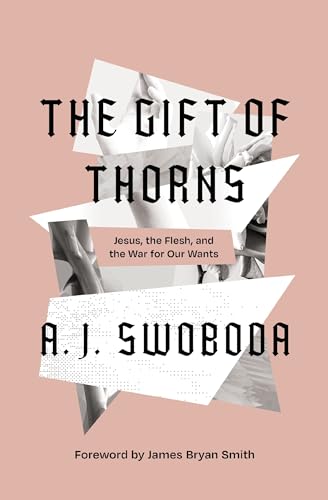
How are we to think about our desires? Are they essentially good or fundamentally fallen? Should we divinize and indulge them or demonize and deny them? To help us wrestle with such questions, A. J. Swoboda, assistant professor of Bible and Theology at Bushnell University, has written The Gift of Thorns: Jesus, the Flesh, and the War for Our Wants. The book’s subtitle is clarifying, for what Swoboda has produced is both a biblical theology and a pastoral theology of desire. It is, therefore, as much a study in discipleship as it is in dogmatics. Indeed, as James Bryan Smith expresses in the foreword, its purpose is to explore “the essential role of desires in our formation into Christlikeness” (p. xv).
Consistent with this aim, The Gift of Thorns is not just theological but also personal—Swoboda often shares painful aspects of his own life and struggles. While laden with exegetical reflections and numerous citations drawn from a wide range of authors, the book also contains numerous anecdotes and illustrations, and many sections have an engaging, sermonic quality to them. In short, this is a skillfully written book that is a delight to read and is rich in IPP—Insights Per Page! This is aided by the fact that Swoboda is the master of the pithy, memorable, and often alliterative sentence. Here is a small sample from the first chapter:
“We cover rather than confess.” (p. 6)
“Darkness isn’t eradicated through denial.” (p. 7)
“We become the stories we tell ourselves about ourselves.” (p. 13)
“We aren’t lucky. We are loved.” (p. 13)
“Humans desire because God desires.” (p. 16)
“Human wants are birthed from lack. Divine wants are birthed from love.” (p. 20)
“A perversion always implies a purpose.” (p. 22)
Before turning to the book’s contents, a word about the main title is in order. As part of his exposition of how our created desires have been corrupted by the fall and are now being reordered in Christ, Swoboda draws attention to the biblical theme of thorns, especially its first appearance in Genesis 3:18: “The land will produce thorns and thistles for you” (p. xxvi, emphasis original). As thorns “represent a world in which things don’t go the way they should,” they frustrate and cause pain. However, the reason Swoboda has italicized the word “for” is because he sees “these intentional inconveniences built into our everyday existence not as bugs, but as features—not as problems, but as gifts” (p. xxvi). Thorns are thus key to the reformation of our desires!
The body of the book is comprised of four parts. “Part 1: The War for Our Wants” begins with a chapter on “God’s Desire” (ch. 1). This is not simply because Genesis 1 reveals the divine determination to create a cosmos but because Scripture as a whole unfolds “the story of God’s desire” (p. 7). Chapter 2 (“Human Desire”) makes the point that “humans are creatures of desire simply by virtue of having been made by a Creator of desire. We reflect our Maker” (p. 25). This not only confirms the goodness of created desires but shows why Christianity “isn’t a hospice for desire. It’s a hospital for desire where it can be healed, restored, and resurrected to its original design” (p. 28). The final chapter in Part 1 is titled “Satan’s Desire” (ch. 3). As Scripture demonstrates, the devil often “awakens our desires by insinuating we are missing out” (p. 63). This both spotlights the fact that sin is essentially “the act of seeing and taking something that isn’t given by God” (p. 62) as well as pointing ahead to the solution: “there is no such thing as ‘missing out’ when we are in Christ” (p. 63).
In the opening chapter of “Part 2: The Disordering of Our Desires,” Swoboda delves into the dark domain of “Fleshly Desire” (ch. 4). This chapter is full of valuable insights but, puzzlingly, attaches the corruption of human desires to our separation from “God’s sustaining presence” (p. 70)—although he later affirms that “we’re all born with disordered souls” (p. 87). The chapter also includes the questionable claim (more Catholic than Reformed) that “experiencing the flesh’s desires isn’t a sin. Following them is” (p. 77). Nonetheless, his exposition of the believer’s daily battle with indwelling sin and the relevance of Paul’s “thorn in the flesh” are both penetrating and encouraging. Chapter 5 (“Waning Desire”) explores “desire loss”—for God, church, prayer, etc. (p. 105)—and the relationship between duty and desire—“the two feet of discipleship” (p. 100). Chapter 6 (“Undesired Desires”) grapples with the fact that “not only do we have unwanted desires; we are composed mostly of them” (p. 116, emphasis original). How then might these be purified? Later chapters explore this question further, but here Swoboda affirms the Puritan insight that “God makes us holy by giving us what they call the ‘strokes’ or ‘crosses’—not by giving us what we want” (p. 119).
“Part 3: The Nurture of Our Longings” opens with a chapter on “Killing Desire” (ch. 7). Here the author returns to the question of concupiscence, “that pulsating desire in all of us for that which God does not want” (p. 134). He also offers a more balanced account of temptation, noting that while some enticements to sin come from outside of us, often “evil simply needs to affirm desires already resident within us” (p. 137). Still, the good news for believers is that although progress is painful and the journey lifelong, “choosing to give up one’s false loves and letting them rest under a love for God” is something the Spirit makes possible (p. 135). In “Nurturing Desire” (ch. 8), Swoboda continues to explore the reconstruction of our desires. One key insight (of many) in this chapter is that when we fail “to see ourselves as children desired and noticed by the Father, we end up needing others to desire and notice us to feel fulfilled.” We then “place an invisible yoke on others to fill our emotional debts” (p. 166). Chapter 9 (“Ordering Desire”) is, yet again, brimming with wisdom: e.g., “We are and become what we love” (p. 173); “Idolatry … is a life given over to a particular false love” (p. 175, emphasis original); “We tend, by law of nature, to pick up the desires of those around us” (p. 182); and contentment “is not the absence of desire. Rather, it is a desire rightly ordered to that which we are given by God” (p. 177).
The final part of the book (“The Revival of our Passions”) begins with a chapter titled “Resurrecting Desire” (ch. 10). Here Swoboda offers a couple of curious lines of arguments, where the conclusions do not clearly follow from the premises: e.g., “Evil is the abuse of the good. This is why Joseph can say to his brothers …, “You intended to harm me, but God intended it for good’ (Gen 50:20)” (p. 200). Nevertheless, his answers to the questions, “How do we wake up our desire?” (p. 205) and “Will we continue to want in heaven?” (p. 208), are thoughtful and stimulating. The theme of desire’s fulfilment is brought to a climax in the book’s final chapter (“Longing Desire”). Here Swoboda explores the fact that, in God’s gracious dealings with us, delayed gratification is often the key to “awakening and maturing our desire” and “also a great revealer of our false gods.” Consequently, “Waiting is often treacherous” (p. 220). Our hope, however, is that when the parousia takes place, our “desire will be resurrected” and “will find what it has always sought.” And yet, writes Swoboda (echoing Augustine’s thought at the end of The City of God), it “still won’t be satisfied. For the face it has always sought will take endless time to take in” (p. 222).
A few final reflections. The Gift of Thorns is a book worth reading more than once. Even though some of the author’s observations and conclusion may be debatable, it will make you think and make you pray. While not all readers will enjoy Swoboda’s prose as much as I did, and some may wish for structural indicators (e.g., subheadings) to elucidate the shape and development of each chapter’s argument, my encouragement is to allow him to take you on the journey he has mapped out and, along the way, to ponder the many interesting landmarks he points out. For when it comes to the redemption of our desires, thorns really are a gift and, without doubt, “the one who bore those thorns is God’s greatest gift” (p. 224).