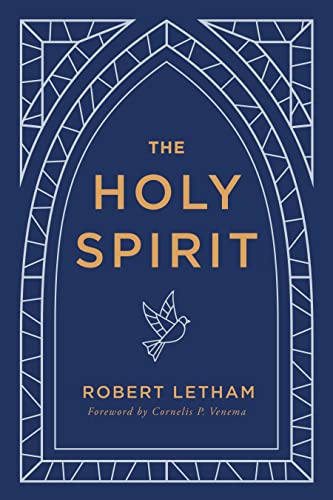
Robert Letham, professor of Systematic and Historical Theology at the Union School of Theology in England, is the author of numerous books, including his recent Systematic Theology (Wheaton, IL: Crossway, 2019). The Holy Spirit is the first book in a series of three that will explore the persons of the Trinity. The volume is divided into two parts: each chapter is followed by key terms and review questions to assist the student, and a glossary is provided with definitions to bold terms that are sprinkled throughout the body of the text.
The first part contains four chapters dedicated to the historical-theological developments of the doctrine of the Holy Spirit. Chapter 1 traces the development from the time of Irenaeus to the First Council of Constantinople. The second chapter begins with Augustine and concludes with the Filioque Controversy. The third chapter moves from Thomas Aquinas to Karl Barth. And the final chapter provides an exposition of the Niceno-Constantinopolitan Creed.
The second part (chs. 5–11) focuses on the biblical teaching on the Holy Spirit. Chapter 5 focuses on the teaching of the Old Testament. Chapter 6 surveys the Holy Spirit’s role in Jesus’s life and ministry. In chapter 7, the author extends their analysis of the Holy Spirit’s involvement in Jesus’s resurrection and ascension, at Pentecost, and in other parts of the book of Acts. The remaining chapters (8–11) are more theological and practical in nature, addressing such topics as the Holy Spirit’s function in the church, salvation, eschatology, the nature and role of spiritual gifts, and how we can discern the work of the Spirit.
Readers familiar with Letham’s works will expect his exposition to be biblically informed, historically sensitive, theologically nuanced, and pastorally relevant. They will not be disappointment with this addition to Letham’s corpus.
It will appear odd to some that, unlike his book on the Trinity, he starts with historical theology. Letham argues, however, that this pedagogical choice serves to establish the divinity of the Spirit and the Spirit’s inseparable operations from the work of creation and salvation executed by the Father and the Son and to avoid “chronological snobbery” by resisting the tendency to ignore “the cumulative wisdom of the people of God down through the ages,” which only serves “to reinvent the wheel and frequently regurgitates old errors and heresies” (p. xx).
Letham is to be commended for pushing against a biblicism that would seek to bypass the voices of the church through the ages that have wrestled with questions surrounding the Holy Spirit. However, this does not mean that the author slavishly follows the formulations of esteemed orthodox theologians, seen, for instance, in his criticism of John Owen’s formulation of Christ’s human dependency on the Holy Spirit, arguing that said formulation opens the door “to Nestorianism” (p. 98).
Furthermore, Letham provides a nuanced discussion of the filioque clause wherein he meticulously leads the reader through the details concerning the rejection of the clause by the Eastern Church and the confirmation and counterargument in favor of it by the Western Church. While discounting the Eastern perspective’s argument that the West undermines the Father’s role as the sole source of Holy Spirit, Letham concurs in that the filioque appears to confuse the Father and the Son and defends the Eastern view against charges that it unduly separates the Son from the Spirit and thus is decidedly lacking in Christocentrism. Ultimately, Letham leans towards the Eastern view of the filioque, affirming the formulation that the Holy Spirit proceeds “from the Father through the Son” (p. 56). Not all will agree with Letham’s assessment, which is of special interest as it comes from the pen of a Reformed (and so Western) theologian. Those with a more Western approach can agree that the filioque clause does not adequately express the relationship of the Holy Spirit to the Father and Son and so, at a minimum, needs to be supplemented by further theological formulation.
Letham, rightly recognizing the influence of Pentecostalism and Charismatic theology, discusses this phenomenon throughout the book, addressing such issues as the nature of the Spirit’s baptism, and the role and function of the spiritual gifts as described in the New Testament and in the Pentecostal/Charismatic movements.
Letham argues for a cessationist position, namely, that “extraordinary gifts of the Spirit … ceased with the passing of the apostles” (p. 296), although he sees the label “cessationist” as unhelpful because it “implies that these gifts were … normally present in the covenant community on an ongoing basis but suddenly stopped” (p. 296). Rather, he argues that the supernatural gifts were never normative for the church but merely accompanied unique and decisive points in redemptive history (e.g., Jesus and the apostles’ ministries) and thus are no longer needed as we await the parousia. Therefore, for Letham, the movements attached to Pentecostalism “cannot … be judged to be in harmony with the biblical gospel and the Christian tradition” (p. 297) since they are based on experience rather than the Bible and the historical orthodoxy of the church.
One wishes at this point that the author would have more deeply engaged with the work of Vern Poythress on this question since it could have facilitated a more sympathetic approach to these movements rather than one that sees them as opposed to the very foundation of the Christian faith. However, it is our hope that non-cessationist brethren will profit from Letham’s criticisms and perhaps see it as motivation to shore up their theology so that it will not give way to Letham’s very concern.
In sum, Letham’s treatment of the Holy Spirit would be helpful to the undergraduate student or busy pastor. It contributes to the ever-growing literature on the third person of the Trinity and provides an orthodox, Reformed perspective that is much needed in these discussions.