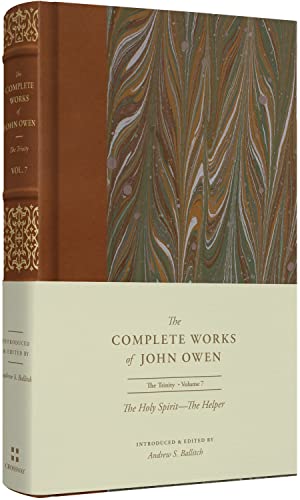
John Owen (1616–1832) was a pastor, theologian, statesman, chaplain to Oliver Cromwell, and the vice-chancellor for Oxford University. He is known as the “Prince of Puritans” due to his extensive theological works and their influence during his day and centuries later. Owen taught that Christian doctrine directly influences the Christian life, and this can be seen in his teaching on the role of the Holy Spirit.
Two of Owen’s treatises dealing with the Holy Spirit, The Reason of Faith and The Causes, Ways, and Means of Understanding the Mind of God, are found in volume 7 of the new The Complete Works of John Owen series by Crossway publications. This volume includes a seventy-page editorial introduction, along with updating the spelling to modern American standards, making this edition more accessible compared to the traditional William H. Goold edition. Goold’s edition of Owen’s works was first published in 1855 and then later reprinted several times by The Banner of Truth Trust.
After a historical introduction to Owen’s theological context, Ballitch gives an outline and summary of each treatise included in this volume and in the next – volume 8. These editorial outlines and summaries will make Owen’s works more accessible than before. The main purpose of each treatise and each chapter is explained and summarized to help the modern reader follow Owen’s arguments. This section of the editorial introduction consists of approximately ten pages for each of these two treatises.
When considering The Reason of Faith, Ballitch explains the question this work seeks to address and the suggested answer. He explains, “the foremost question on his [Owen’s] mind in writing this treatise was, Why do Christians believe the Scripture to be God’s word? In short, his answer is this: The reason of faith is God’s authority and veracity revealing themselves in the Scriptures and by them” (p. 33). In William Goold’s edition of this treatise, there is only a single page given to introduce it. But Goold does state the question at hand when he explains, “[It] is occupied with an answer to the question, on what grounds, or for what reason, we believe the Scripture to be the word of God?” (The Works of John Owen [Carlisle, PA: The Banner of Truth, 2017], 4:4). However, Goold’s edition does not lay out a brief suggested answer to this section like Ballitch does in the newer edition.
The Reason of Faith contains seven chapters. In chapters 1–2, Owen introduces the topic of divine revelation and how Scripture is the infallible Word of God while also explaining how the Holy Spirit is necessary to understand it. In chapters 3–4, external arguments are examined and explained to be insufficient to prove that Scripture is God’s divine revelation. In chapters 5–7, God’s Word is established as the only foundation and reason of faith.
In the volume’s second treatise, The Causes, Ways, and Mean, Ballitch’s editorial notes again are helpful. He explains, “In Causes, Owen offers the method by which we understand the divine mind revealed in Scripture” (p. 40). In Goold’s edition of this treatise, the editorial notes are minimal, again consisting of only a single page. However, Goold’s overarching summary also concisely explains, “[This treatise] relates to the method by which we are to understand and interpret Scripture aright” (The Works of John Owen, 4:118). This treatise contains nine chapters. Ballitch helpfully explains, “Chapters 1–6 expound the Holy Spirit as the principal efficient cause of right interpretation, and chapters 7–9 explain the means of proper understanding” (p. 40). In this treatise, one of Owen’s main points is that Scripture is not primarily about knowledge but transformational knowledge, and this transformation only occurs with the Holy Spirit.
Crossway has made Owen’s works more accessible in this newer series with the updated English and extensive editorial notes, while also adding new works by Owen that have never been published before: prefaces Owen wrote for others and several of his letters. This newer series, including this particular volume, has also translated all the Hebrew, Greek, and Latin words and phrases into modern English while still retaining the original languages for scholarly reference.
This particular volume should make every Puritan scholar and interested pastor or layperson excited for the release of the remaining volumes in the coming years. There will be random mistakes and typos (There is a typo on page 5 in this volume when it says the Barebones Parliament was in 1553 instead of 1653). Still, this new set of John Owen’s works will be invaluable for this generation and the next for Owenian scholarship and devotional reading.