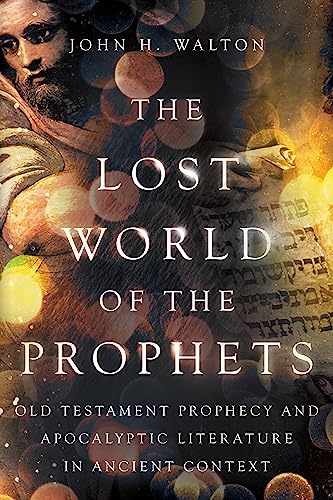
The prophetic and apocalyptic books of the Old Testament provoke both fascination and confusion for modern readers. Some see them as cryptic yet mesmerizing, roadmaps that reveal God’s plans for the future. Others see them as hopelessly impenetrable and difficult to appropriate for a contemporary Christian context. As a result, prophecy is often misunderstood or avoided altogether. The Lost World of the Prophets, the latest installment in John Walton’s Lost World Series, was written to help readers better understand prophecy as a phenomenon in ancient Israel and its literary expression in the prophetic and apocalyptic books of the Old Testament.
John Walton is Emeritus Professor of Old Testament at Wheaton College and Graduate School. As with many of his books, The Lost World of the Prophets seeks to bridge the gap between Old Testament scholarship and non-specialist readers who hold a high view of Scripture. A key concern is to help readers recognize the influence of their “cultural river” (i.e., values, beliefs, and worldviews that are shaped and influenced by their culture or subculture) on their reading of Scripture and the importance of reading the Old Testament in light of the “cultural river” of Israel and the ancient Near East (p. 6).
The Lost World of the Prophets is structured around sixteen propositions about prophecy, prophetic books, and the interpretation of prophetic books. These propositions are divided thematically into five sections. Section 1 deals with prophecy in the context of the ancient Near East. In the first proposition, Walton argues that prophecy is best understood as a form of divination, which he defines as any means by which human beings receive communication from the divine realm (pp. 13–14). When viewed as a subcategory of divination, information about prophets and other diviners in Mesopotamia can illuminate both the nature and function of prophecy in the Old Testament. Perhaps the most important insight to be gleaned is that prophets were not predicters of the future but individuals who announced the plans and thinking of God (p. 27). These messages, like weather reports, were meant to warn their recipients and call them to change their ways so they could avoid the projected plan for the future (pp. 16–17).
Section 2 deals with prophecy as a phenomenon. For the sake of brevity, we will limit ourselves to a discussion of the third proposition. In this proposition, Walton expands on the idea that prophets were not predictors of the future but functioned as spokespersons who announced the plans and thinking of God (pp. 35–36). According to Walton, prediction is an inappropriate category for prophecy since it assumes that God has no causal role in the predicted events (p. 36). God does not predict; he decrees (p. 36). Walton devotes a significant amount of space under this proposition to three prophecies that include specific information about the future: the prophecy about Josiah in 1 Kings 13:2, the prophecy about Bethlehem in Micah 5:2, and the prophecies about Cyrus in Isaiah 44 and 45. Some readers may find Walton’s discussion of the first and third examples problematic. For the prediction about Josiah, Walton points out that Kings reached its final form after the time of Josiah (p. 39). This means that the name Josiah may have been added to this prophecy after the fact. While this is certainly possible on a historical-critical level, it seems to me that Walton’s understanding of prophecy and his concern for divorcing it from prediction has forced him to exclude evidence that does not fit with his paradigm. In this regard, it is important to remember that although the final form of Kings can be dated to the exilic period, its source material is much older.
Section 3 deals with the prophetic books of the Old Testament as literature. Walton includes several propositions that help readers become better interpreters of prophetic books. He includes a brief discussion of the main subgenres used in prophetic literature (proposition 7), a discussion of how prophetic books were formed (proposition 8), and a brief section about the implied audience of prophetic books (proposition 9). Although these propositions are quite useful as a whole, some readers may find his discussion of Isaiah under proposition 9 to be problematic. In this section, Walton describes the position that Isaiah’s original prophecies were supplemented in later generations by inspired prophets who added relevant material for the exilic (Second Isaiah) and post-exilic (Third Isaiah) periods (pp. 81–83). Although Walton is non-committal about whether this position is correct, the weight he gives to this view—combined with his explanation of why the name Cyrus is included in Isaiah 40–55 (p. 43)—suggests to readers that this view is a legitimate option for people who hold a high view of Scripture. The sheer weight he gives to this issue may even suggest to readers that this is the preferable option.
Section 4 deals with prophetic fulfillment, while the final section deals with Apocalyptic literature. Both sections provide helpful and practical insights for the reader.
Overall, The Lost World of the Prophets provides an excellent introduction to both prophecy and the prophetic books of the Old Testament. It effectively bridges the gap between Old Testament scholarship and non-specialist readers and yields many fascinating insights along the way. However, some readers may find that Walton’s views on prophecy may overwhelm his interpretation of some prophetic texts.