Jesus asks, “Who do you say that I am?” This is the central question of Mark’s Gospel. It is also the central question of the entire Scriptures and the most important question that hangs over each individual life. The late theologian and pastor R. C. Sproul was repeatedly asked what he thought was the biggest issue faced by today’s church. His answer was always Christology. Christ’s question to his disciples in Mark 8:38 is one of perennial importance and contemporary urgency.
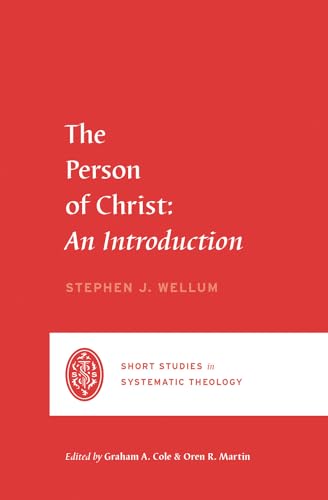
Stephen J. Wellum helps the church wrestle with this question in The Person of Christ: An Introduction. Wellum is professor of Christian Theology at The Southern Baptist Theological Seminary and is well poised to provide readers with a lay of the land where christological issues and their controversies are concerned. In this addition to the Short Studies in Systematic Theology series, Wellum gives a robust articulation of classical Christology.
The book is divided into three sections: Biblical Foundations, Theological Formulation, and Theological Summary. The first section displays how a high Christology emerges from the pages of Scripture. Wellum unabashedly writes a Christology from above, from the perspective of the Scriptures and creedal tradition, as this “provides warrant for the Bible’s and the church’s theological confession of Christ” (p. 28). Wellum contends that a Christology from below, from a historical-critical perspective, “never leads us to faith in God the Son…” (p. 31). The second section is a brief but intensely detailed overview of the theological formulations that occurred in the early centuries of Christianity. The major issues and players are described, as well as the major heresies which led thinkers astray. It is here that students or interested readers can get a good grasp of terms and definitions that the early church deliberated so intensely upon. Wellum shows how necessary it is to go beyond the Bible’s vocabulary, as this helps safeguard the Bible’s witness to the central question of the person of Christ. His concluding section describes a robust orthodox Christology which is faithful to the Scriptures and consistent with the councils of the Patristic era. The three-section structure of the book succeeds at presenting the case for an orthodox Christology. While biblical studies and systematic theology are often, sadly, at odds, Wellum positions them as horses pulling together in the same direction toward his central question: Who do we say Jesus is?
It is hard to find things to dislike in this short volume, as Wellum so capably covers the major issues of Christology. He explores certain topics in detail, such as post-Chalcedonian developments and the distinction between anhypostasia and enhypostasia (pp. 109–14). At other points, he gives only a passing glance to aspects of Christ’s person, for example, his role as the agent of creation. Any weaknesses of The Person of Christ can be attributed to its brevity and not to the quality of its reasoning. Its slender profile, however, constitutes an advantage. This volume, as with others in the series, is perfectly suited for theological students and learned laypersons. It provides a good grounding in the broad contours of christological thought and controversy. It is, after all, intended—along with the rest of the series—as an introduction. One can easily imagine The Person of Christ serving as a launching pad into the broader field of Christology and thereby into more comprehensive books on the subject.
Wellum does not shy away from asserting his own positions regarding things like whether Christ’s humanity is fallen or unfallen. According to him, it is unfallen, though he does not delve far into this discussion. The fallen view is not so easily dismissible, though, as it has been held by T. F. Torrance, Karl Barth, and possibly even Athanasius. Wellum perhaps passes too quickly over this debate. He does, however, press into the issue of Kenotic Christology and the various views on what it means for Christ to have “emptied himself” as in Philippians 2:7 (pp. 127–44). Chapter 7, “Current Challenges to Christological Orthodoxy,” is one of the book’s main highlights. Wellum thoroughly shows various kenotic theories to be misaligned with Chalcedonian commitments. This demonstration is particularly apt, as it might be surprising to encounter an Arian-style denial of Christ’s full divinity in evangelical pulpits. However, it is not uncommon to hear some form of kenoticism articulated there.
Wellum ultimately helps us see Christ—the One who questions each one of us: “Who do you say that I am?” Through The Person of Christ we see Jesus Christ portrayed as completely unique, worthy of all obedience, and as the appropriate object of all our adoration.