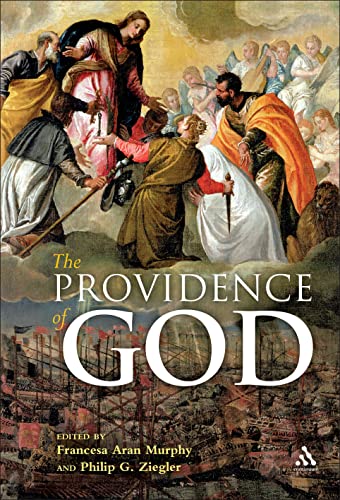
This is a substantial volume arising from a conference on providence organised at the University of Aberdeen. The papers look at the topic from a number of different angles and offer fresh and varied treatments which are, in the main, interesting and instructive. The titles of the chapters and their authors are as follows:
Part I: History of the Doctrine of Providence:
- Matthew Levering, ‘Aquinas on the Book of Job: Providence and Presumption’
- David Bentley Hart, ‘Providence and Causality: On Divine Innocence’
- Francesca Aran Murphy, ‘Providence in 1 Samuel’
- Cyril O’Regan, ‘Hegel, Theodicy and the Invisibility of Waste’
- Andrew McGowan, ‘Providence and Common Grace’
Part II: Doctrines of Providence: Systematic Theology
- Douglas Knight, ‘Time and Persons in the Economy of God’
- Katherine Sonderegger, ‘The Doctrine of Providence’
- John Webster, ‘On the Theology of Providence’
Part III: Science and Providence
- Sarah Coakley, ‘Providence and the Evolutionary Phenomenon of “Cooperation:” A Systematic Proposal’
- Alister E. McGrath, ‘The Secularization of Providence: Theological Reflections on the Appeal to Darwinism in Recent Atheist Apologetics’
- Nicholas J. Healy, ‘Creation, Predestination and Divine Providence’
Part IV: Providence, Politics, and Ethics
- Stephen H. Webb, ‘From Prudentius to President Bush: Providence, Empire and Paranoia’
- Charles Mathewes, ‘Providence and Political Discernment’
- John Swinton, ‘Patience and Lament: Living Faithfully in the Presence of Suffering’
- Hans S. Reinders, ‘Why This? Why Me? A Theological Reflection on Ethics and Providence’
- Philip G. Ziegler, ‘The Uses of Providence in Public Theology’
There is an epilogue by David Fergusson.
Given my own interests in Calvin and providence, and in divine causality more generally, my attention was first drawn to the two papers that feature these topics. Andrew McGowan discusses the common-grace views of the Dutch Calvinists Bavinck and Kuyper. While they, and McGowan, think that the notion of common grace warrants a positive relationship between the Christian and culture, it is not obvious why natural law, a much more prominent theme in Calvin, after all, does not do the same. The neo-Calvinists’ idea that natural law is necessarily ‘Pelagian’ does not stand up to scrutiny. In one of two papers on providence and suffering (the other is by John Swinton), particularly the suffering that arises from various kinds of disability, Hans Reinders reflects helpfully on Calvin’s view of providence in its practical operation, providence as ‘trust and obey.’ He skirts the theme of abandonment to divine providence, a theme which surprisingly is not otherwise treated in this book. The material on divine causation in providence (chaps. 1–3) shows a dislike for the very idea, but has nothing much to put in its place. There are, after all, a limited number of options in this area, and by now they are pretty well-worn.
I enjoyed the papers on politics. Philip Siegler juxtaposes the Puritan Putney debates about discerning the mind of God in politics with that of Barth and the German Church movement. The Puritan debates highlight how pathetic they once were, for all their godliness and love of the Scriptures, in failing to realise in practice what they knew in theory, that the secret things belong to the Lord our God and the revealed things to ourselves. Puritan politics became a game of trying to second-guess what the Lord would do next and trying to align themselves with it. Such a project, and the mentality that it expresses, was doomed to failure. The Lord may have been on their side, but not in quite the way that they believed and no doubt at last realized. Stephen Webb shows that the same difficulty about being on the right side of the course of providence afflicted the politics of President George W. Bush.
Besides the chapters which I have chosen to comment on, I thought that the paper of John Webster’s, who also skirts the issue of activity and passivity in relation to providence, is particularly fine.
As will have become clear, this is a volume to dip into and one that (because of its variety and the generally high standard of the contributions) may confidently be used as a resource for teaching a course in providence. However, in one place the book is marred by language used by David Bentley Hart about views of divine causality different from his own: the views are ‘degenerate’ theology, guilty of ‘absurdity’ and ‘moral idiocy;’ ‘sterile,’ ‘repellent.’ Such language has no place in the adult discussion of difficult ideas, let alone in Christian courtesy, and the editors ought not to have let it pass.