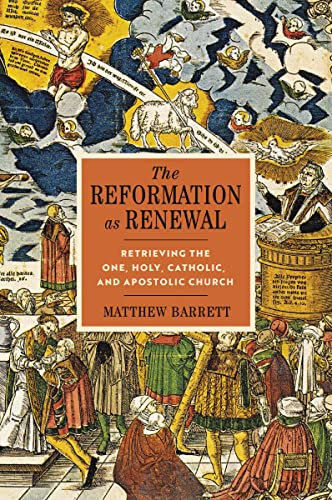
In this impressive volume, Matthew Barrett has done readers a great service. He has summarized massive amounts of Reformation and early modern research with the goals of combating stereotypes and negative assessments of the Reformation, as well as demonstrating that the sixteenth-century reformers were not trying to start a new church but were self-consciously claiming a connection and inspiration, from the early church, the ecumenical creeds, and the best of medieval thought. Barrett has scoured numerous sources, doing the heavy lifting that most of us do not have time for. But this book is not just a summary of other research—in many instances, Barrett charts his own path, correcting or disagreeing with various scholars and interpretations. While Barrett does not claim to do original research, he connects many themes and figures across time periods and even theological disciplines, producing a volume that should be helpful for a wide readership.
Barrett is a professor of Christian theology at Midwestern Baptist Theological Seminary and has distinguished himself as an interpreter of classical Christian theology, especially in the area of Trinitarian theology (with his Simply Trinity: The Unmanipulated Father, Son, and Holy Spirit [Grand Rapids: Baker Books, 2021], among other volumes). Now, he takes that same concern to retrieve the best of church history and the Great Tradition and demonstrates that this was a key concern of the sixteenth-century Reformers as well.
A subtitle of the book is “An Intellectual and Theological History.” It spans the Medieval period to the Counter (or Catholic) Reformation. Barrett begins with a deep dive into Medieval theology. This is important for several reasons. First, he engages with the theological creativity of the supposedly “dark ages” and highlights the high level of theological development and sophistication that was achieved in this period. Secondly, he explains how the Reformers, especially Martin Luther, were reacting to late medieval developments in a certain type of Scholasticism, namely the via moderna movement. So, when Luther and other Reformers rejected the “scholastics,” they were really rejecting a narrow school of scholastic thought, which was not representative of the best of medieval thought. Thirdly, Barrett concludes that the Reformers were indebted to medieval theology in many respects. This helps us see the Reformation as a logical and perhaps necessary development in church history rather than an abrupt rejection of everything that came before it. Barrett supplies ample proof that the Reformers saw themselves as reclaiming the catholicity of the church, a catholicity founded on the Bible but in conformity and continuity with the earlier creeds, councils, and teachings of the church fathers.
To his credit, Barrett does a superb job of letting each thinker and theologian speak for themselves. Even when he clearly disagrees with someone (like Gabriel Biel), he articulates Biel’s position carefully and saves his analysis for later. When reading his summary of Luther, I thought Barrett might secretly be a Lutheran, and likewise for his treatment of other theologians. This objectivity and letting sources speak for themselves is something more scholars should strive for.
In a book this size, there are bound to be shortcomings. The text was, unfortunately, marred by quite a few typos, although they were minor and did not affect any of the book’s main points. Additionally, at times, the narrative was too focused on the details of individual lives and events. For instance, it was not clear if it was necessary to recount so many details about the life of St. Anselm in order to summarize the main points of his theology. Sometimes, the book turned into a historical theology, dwelling on the details and nuances of various theologies and thinkers, only to return back to the main point of arguing for the catholicity of the Reformation. It gave the impression that Barrett was writing two books at the same time: one, a historical theology, and the other, a more focused argument for the catholicity of the Reformation. However, given the general historical amnesia of contemporary American evangelicals, I appreciate his attempt to tell the story of medieval theology in particular and show its continuities with Reformation theology.
Overall, this is a superb accomplishment and a labor of love. This book will be useful for students, interested readers, and even for established scholars. Barrett loves the Reformation and the Reformers while honestly admitting the shortcomings of both. This book should energize a new generation of scholars to take up the task of renewing the church by retrieving the legacy of the truly catholic tradition, thereby continuing and extending the legacy of the sixteenth-century Reformers.