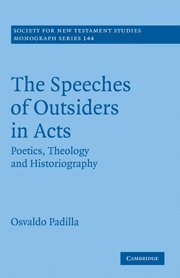
Padilla begins this work by discussing the role the “Other” has in shaping community identity. He notes that while Peter gives nine speeches in Acts and Paul eight, “outsiders” as a group give seven, and this comparatively high number indicates a need to study these neglected speeches of outsiders to see how they functioned in helping the early Christian community define itself. Given that the speeches of opponents are also sources for understanding Luke’s theology, “it is thus puzzling that NT scholarship has yet to explore the implications of Acts’ presentation of the opponents of the Jesus movement” (p. 6). Padilla seeks to shed light on Luke’s theology, the genre of Luke/Acts and the purpose(s) for writing Luke/Acts by exploring the speeches of outsiders. After describing the overall goal of the study, Padilla spends the rest of chapter 1 discussing issues of method. He treats Acts through the tools of narrative criticism and rhetorical criticism, in particular focusing on “dramatic irony.” Thus, he states that he treats Acts in its final form, is interested in the theological significance of the narrative, and assumes that the original audience expected the speeches to relate to events in the real world. Padilla considers the “what” and the “how” of the speeches of outsiders within Luke’s narrative. The author notes that he uses the terms Luke, author, implied author, and narrator interchangeably, asserting that it is doubtful that the author of a work of a historical nature sought to be distinct from a persona of the narrator as the author of a “transparently fictional” work would (p. 11).
Chapter 2 reviews and assesses the history of research on the speeches in Acts from the Tübingen School to the present. Padilla concludes that there has been little attention to the speeches of outsiders by authors who have written on the speeches in Acts, such as Baur, Cadbury, Dibelius, Bruce, Soards, and Penner, because they do not have a significant place in the discussion of the historicity or historiography of Acts. Padilla asserts that the speeches of outsiders in Acts are much more like those in the Hebrew Bible or Second Temple literature than in Hellenistic historiography.
Chapter 3 looks at the use of speeches by outsiders in narratives in the Hebrew Bible and Second Temple literature as background for understanding the speeches of outsiders in Acts. Padilla argues that the speeches of outsiders in these texts, from Nehemiah to Daniel to 1 Maccabees to Addition E in Greek Esther, all have an outsider who had hubris towards the Jewish people (e.g., Nebuchadnezzar) and gives a speech that affirms the theology of the Jewish author of the work. The notable exception is Josephus, who does not have such speeches. These speeches affirm the sovereignty of the God of Israel over the whole world.
Chapters 4–7 examine specific speeches of outsiders, beginning with Gamaliel’s in Acts 5. For each speech, Padilla examines the context, setting, characters, and plot, followed by looking at the speech itself. The results of each of these are used to determine the function of the speech in its context and in Acts as a whole. Padilla offers many detailed observations that bring to light many details of each speech, which is helpful in its own right. Gamaliel’s speech in Acts 5 illustrates his analysis. Padilla states that Gamaliel’s speech, according to many scholars, has an apologetic purpose for Luke in showing that Christianity cannot be destroyed. He agrees with this conclusion but asserts, “the means through which [this conclusion] is reached lacks literary nuance and thus its credibility may be jeopardized” (p. 127). Padilla rejects the view of Fitzmyer and others that Gamaliel’s speech served to legitimate Christianity because the Christian movement, unlike others, had survived the death of its founder. Rather, Gamaliel asserts that Christianity may be true if it stands the test of time. Padilla demonstrates that Gamaliel’s speech uses dramatic irony and that if it is “apologetic,” it is not intended for outsiders, but for those who already embrace Luke’s viewpoint and is closest to an apologetic of “legitimation/self-definition” (p. 132). Dramatic irony for Padilla is a technique that would have been most persuasive to insiders. Within Acts 5:17–42, Gamaliel’s speech serves as the action transformatriceas it “moves the action into a specific horizon” (p. 134). Most of the speeches of outsiders in Acts serve a similar role as “transformative action.” Some speeches serve ironically in their results by promoting the mission of the apostles. Padilla concludes that the speeches of outsiders in Acts have a legitimating function for its readers.
Overall, this is a helpful, well-researched study that contributes to Luke-Acts scholarship on a relatively neglected topic. There is an issue over Padilla’s selection of speeches, however, in that he does not analyze all the speeches of outsiders. For example, he explicitly omits the speech of the owners of the slave girl in Acts 16:20–21 because it “appears that Luke has cast the words of these outsiders in direct speech primarily to provide variation in his narrative” (p. 5n13). It is difficult, however, to know the author’s “intent” in the speech of one outsider as opposed to another in this regard, so this criterion is questionable. Moreover, the speech in Acts 16 is important because it does not seem to support Padilla’s view that the speeches of outsiders are used to affirm the author’s theological perspective or show that the gospel is advancing no matter what. Padilla ought to deal with speeches that appear to challenge his conclusion, not put them out of bounds on the ground that they represent Luke’s effort at “variation” in his narrative. That would seem to be a reductionistic reading of this and possibly other speeches. Nevertheless, this work will be of value to those researching Acts in general or the speeches of outsiders in particular. Padilla’s assessment of various approaches to assessing the genre of Acts offer important areas for further study.