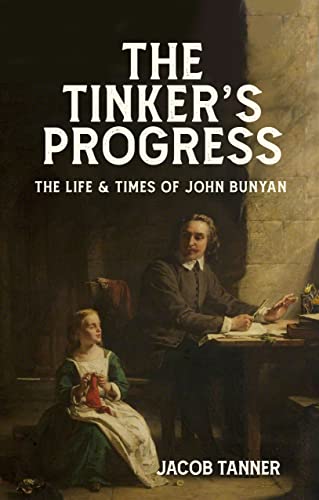
Many Christians today know of The Pilgrim’s Progress, John Bunyan’s masterful allegory of the Christian life. Comparatively few have actually read it. Fewer still have read Grace Abounding to the Chief of Sinners, Bunyan’s autobiographical conversion narrative, not to mention his numerous other works. This is a tragedy that Jacob Tanner seeks to redress in The Tinker’s Progress: The Life and Times of John Bunyan. Tanner’s stated purpose is to reintroduce Bunyan to the contemporary church as a writer no less gifted than Dante, Milton, Lewis, or Tolkien, a preacher no less powerful than Chrysostom or Spurgeon, and a leader no less influential than Augustine, Luther, or Calvin. Most of all, Tanner presents Bunyan as an exemplary Christian (p. 11), a model of “the Puritan spirit of Reformed, experiential theology” (p. 13).
Chapter 1 explores Bunyan’s origins. Bunyan was born into poverty, the son of a tinker (a craftsman who repairs metal implements). He received minimal education, a badge he wore with honor throughout his life, though it was often the object of ridicule from his opponents. Bunyan’s parents do not seem to have possessed an evangelical faith, and Bunyan was, by his own admission, a mischievous and godless child plagued by terrifying nightmares.
Chapter 2 traces Bunyan’s late childhood, during which Bunyan claimed to be “the very ringleader of all the youth that kept me company, into all manner of vice and ungodliness” (p. 38). Tanner also provides a brief overview of England’s political and religious turmoil from the Reformation of the sixteenth century to the civil wars of the 1640s.
In chapter 3, Tanner examines the various providences that led to Bunyan’s conversion: the sudden loss of his mother and sister, leading him to reflect upon his own mortality; a number of near-death experiences from which Bunyan learned the fragility of life; his exposure to Puritan preaching during the civil war; his marriage to a woman who brought Puritan books into the union; crushing experiences of conviction of sin; an overheard conversation of evangelical women speaking of free justification and the new birth; the personal ministry of John Gifford, pastor of the Bedford Church; the gift of a worn copy of Luther’s Commentary on Galatians; and the repeated intrusions of the gospel throughout Bunyan’s torturous quest for assurance.
Chapter 4 covers the early years of Bunyan’s preaching and writing, examining Bunyan’s call to ministry and his earliest published work, Some Gospel Truths Opened. Chapter 5 describes the various persecutions Bunyan endured, including his arrest and twelve-year imprisonment. Bunyan’s sufferings proved productive, for it was in prison that he produced many of his most famous works.
Chapters 6–7 explore Bunyan as a pastor and preacher, respectively. Tanner locates the effectiveness of Bunyan’s preaching in three factors: his ability to preach deep truths with simplicity, his experience of suffering that enabled him to encourage sufferers, and his extraordinary knowledge of the Scriptures that permeates both his preaching and writing.
In chapter 8, Tanner surveys the final years of Bunyan’s life and work. And in the final chapter, Tanner provides seven lessons that readers may learn from Bunyan’s legacy.
The Tinker’s Progress falls into the category of what may be termed “devotional biography,” which differs from critical biography in that the author dons the mantle of pastor rather than historian, offers spiritual application rather than critical analysis, and, unless the author is careful, can sacrifice historical accuracy in pursuit of homiletical vitality. At its worst, devotional biography descends into hagiography as the author distorts the facts and downplays the failings of its subject. At its best, however, devotional biography strives for both accuracy and application, and Tanner achieves this aim. Tanner does not write from a perspective of historical objectivity, nor does he intend to. Rather, he presents Bunyan as a hero of the faith, a model Christian pilgrim. Having spent several years with Bunyan myself, I am inclined to agree. The devotional thrust of The Tinker’s Progress is not a deficiency, provided the reader does not expect objectivity. Critical biographies of Bunyan abound, and the reader could do no better than Richard Greaves’s Glimpses of Glory: John Bunyan and English Dissent (Stanford, CA: Stanford University Press, 2002) or, on the more popular level, David Calhoun’s Grace Abounding: The Life, Books and Influence of John Bunyan (Fearn, Ross-shire: Christian Focus, 2005). As a devotional biography, The Tinker’s Progress is a solid contribution.
There is much to commend in The Tinker’s Progress, but two strengths merit particular mention. First, Bunyan’s conversion narrative, including his agonizing quest for assurance, differs greatly from what many modern evangelicals expect from a conversion account, in which regeneration is decisional and assurance instantaneous. To such, Bunyan’s experience is mystifying and frightening. Tanner, however, presents Bunyan’s experience as normative and his narrative as instructive for modern readers. This is a refreshing change from the reaction many have upon reading Grace Abounding to the Chief of Sinners.
But the greatest strength of The Tinker’s Progress is that it presents Bunyan to a modern audience as more than just the author of The Pilgrim’s Progress. Bunyan was a prolific writer with a keen theological mind, who presented orthodox Puritan theology in an unorthodox fashion across a dizzying array of genres. If The Tinker’s Progress encourages people to take up Bunyan and read, then Tanner’s efforts will be fruitful indeed.