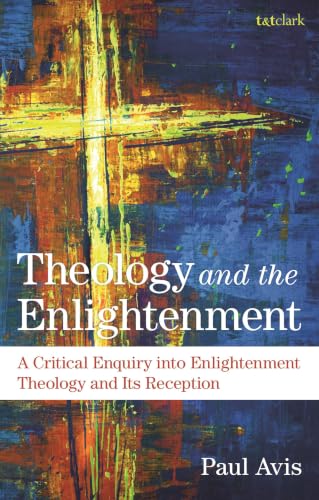
When students engage the Enlightenment in-depth for the first time, they might be surprised. Indeed, much common knowledge does not match the primary sources nor the current state of research. In contrast, Paul Avis offers a broader perspective. The prolific Anglican theologian is Honorary Professor of Divinity (University of Edinburgh), as well as Honorary Research Fellow of Theology and Religion (University of Exeter). He combines high expertise with great personal interest “to examine the Enlightenment’s theological dimension and its reception and interpretation” (p. 273).
In chapter 1 (“Engaging the Enlightenment”), Avis provides a framework by highlighting the lasting cultural significance of that epoch while discussing divergent valuations of modern thinkers (Horkheimer, Adorno, Gadamer, MacIntyre, et al.). Considering its ambiguities, Avis argues for a nuanced interpretation and a critical appreciation and appropriation of the Enlightenment: It “lit up many dark corners of eighteenth-century European and American civilization” (p. 7).
In chapter 2 (“Scapegoating the Enlightenment”), the author turns to several writers and theologians who hold a more critical view. Avis finds their argumentations often misleading or lacking in differentiation. Therefore, chapter 3 (“A Virtuous Enlightenment”) presents some rather conservative protagonists of the Enlightenment – they strove for the advancement of science, the improvement of the people’s living conditions, more tolerance, and freedom of speech.
After that, Avis examines the worldview, religion, and religiosity of some leading Enlightenment thinkers (Kant, Voltaire, Spinoza, Bayle, Rousseau, Hume, et al.). Many remained in an ecclesiastical setting. Others searched for a reasonable, ethical faith and were reluctant towards a confessional standpoint due to the misuse of parochial power and widespread superstition. Thus, the author’s outlook in chapter 4 is a more sympathetic one, namely “that religious faith of one kind and degree or another, but usually Christian, permeated and dominated almost all aspects of the Enlightenment” (p. 149).
In chapter 5 (“The Anglican Enlightenment”), Avis focuses on his own tradition. Building on a renaissance of research, the theologian traces back the convergence of heart-felt religion and Enlightenment ideas, not least in the wake of early Evangelicalism. In his view, for example, John Wesley “reveals himself to be an Enlightenment intellectual in his appeal to reasoned argument, his empiricism in epistemology, his intellectual curiosity and his investigative cast of mind” (p. 228). After a critical discussion on British Deism and on the cultural significance of the early English novel, Avis concludes, “Unlike the situation in France, Germany, Italy and the Netherlands, Enlightenment principles are treated in a non-polemical way and are not presented as a cause of conflict and division. In the Church of England the Enlightenment appears to have been more seamlessly integrated than elsewhere” (p. 271).
In turn, chapter 6 (“Enlightenment History and the Bible”) reviews the new approach to history and humanity that many Enlightenment thinkers tried to reconcile with the cultural imaginary of Christendom. Although their historiography differed according to their own philosophical axioms, they all held to (1) the idea of progress, (2) an organic view of society and a greater appreciation of civil history, and (3) a uniform understanding of human culture and nature. These factors informed varied movements of biblical criticism, which still today seem ineluctable to many. At that point, Avis’s assessment tends towards a more aesthetic, communal, and functional understanding of the Christian gospel and tradition: “While mere historical events alone, as fallibly reported but with whatever wealth of circumstantial detail, cannot either help or harm us, the divine revelation that shines through them to the eyes of faith, addressed to the human imagination and responded to by the whole person within the community of faith, is transformative and live-giving” (p. 334).
In chapter 7 (“The Enlightenment in the Frame of Christian Theology”), the author compares the “coming of age” motifs in the writings of Kant, the apostle Paul, and the German anti-Nazi dissident Dietrich Bonhoeffer. After that, Avis describes the idea of light and Enlightenment as a universal spiritual metaphor, which is visible in the Bible, Christian history, and liturgy. Accordingly, his final plea is that the church should never be complacent or hostile towards its critics but always open to knowledge, truth, and reform. The book closes with an extensive bibliography and an index of names. Unfortunately, there is no subject index.
Undoubtedly, the book has many strengths. Using a multidisciplinary methodology, Paul Avis depicts a complex and realistic vision of the European Enlightenments and their “not-so-atheistic” concerns. His discussion of modern Enlightenment research and reception is extensive and stimulating. At the same time, he includes other important topics relevant to his study; he also gives adequate space to the Enlightenment thinkers and their original voices.
Given the breadth of Avis’s train of thought, some readers will struggle to follow the many threads and themes in the book. An analytical outline or a detailed table of contents would have been helpful. Historical theologians will find some remarks tendentious, at least on a methodical level, for instance: “Orthodoxy and heterodoxy are not fixed quantities in the theological lexicon and have always been slippery notions. They do not place anyone on the broad and shifting spectrum of theological conviction and opinion” (p. 233).
Sometimes the author’s leitmotif seems redundant when he underlines that many thinkers have misunderstood the Enlightenment, which oddly enough seems to be the case each time, when he refers to conservative Christians. At these points, the author’s continuous call for ideological restraint and differentiation takes on a normative undertone. Especially in the final chapter, Avis tries to convince the inclined reader to reject a pre-modern attitude and embrace a more winning Christian Enlightenment mindset. This may reveal more about the author’s premises than it does about critical perspectives; for example, from a conservative theological point of view toward certain traits and trends of the Enlightenment, beyond a rather functional perspective.
However, Theology and the Enlightenment is an interesting study, especially for those who do research in the field of Enlightenment reception history and history of ideas. Students and academics, in general, will be challenged to reconsider their own cultural and ecclesial imprint, wrestle with the church’s past shortcomings, investigate fairly the author’s arguments and presuppositions—and go back to work on the primary sources.