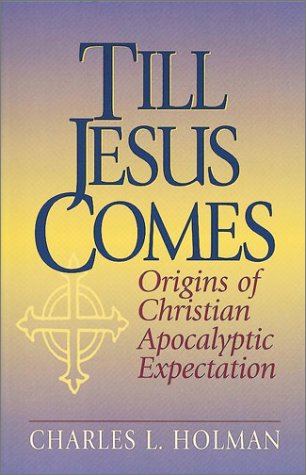
According to the publicity blurbs on the back of this book, it is a ‘timely’ and ‘balanced’ study, as well as a ‘voice of sober and sound biblical proportions’. In it, Holman seeks to discover the Jewish roots of the NT apocalyptic tension between fulfilment and delay, especially as evidenced in three texts: 2 Thessalonians 2; the Synoptic apocalypse (Mark 13 and parallels); and the book of Revelation. In tracing the dual traditions of fulfilment and delay in the OT prophetic and apocalyptic traditions, as well as Jewish intertestamental literature, Holman, rather unsurprisingly, finds evidence of the same tension in Jewish apocalypticism as in later Christian apocalyptic, albeit with significant changes in Christian usage as a result of the Christ event.
What is difficult to understand is how this book can be described as either ‘timely’ or ‘balanced’—the approach almost completely ignores the Greco-Roman background of either Jewish or NT apocalyptic or eschatological expectations, choosing instead to concentrate entirely on Jewish backgrounds. Although the work done on the hellenisation of Judaism over the past century by figures such as Bickerman, Tcherikover, and Hengel has made it virtually impossible to consider any aspect of either Judaism or Christianity from the Greco-Roman period without paying close attention to Hellenism and its extensive influences, Holman manages to side-step most of the crucial issues in this area (his sole concession to this research being the citation of Hengel’s Judaism and Hellenism on a few occasions). As a result, the rather unsurprising contention that the background of the tension within NT apocalypticism is Jewish apocalyptic does little to add to the ongoing discussion of either Jewish or Christian apocalyptic. Although the concentration in NT studies has swung from Hellenistic influences to Jewish backgrounds, the recent work in the area has shown that either approach is too simplistic—one cannot speak of Judaism in this period as anything but Hellenistic. When discussing the Jewish backgrounds and roots of early Christianity, one must take into account both the previous hellenisation of Judaism during the intertestamental period, and the ongoing hellenisation of the whole Greco-Roman world. Had it taken this into account, this study would have had a chance to make a significant contribution to the field.
The strangest aspect of this book, however, is its concern with the expected millenarianism of the upcoming millennium, and the way in which it tries, somewhat unconvincingly, to relate OT apocalyptic expectations, mediated through the NT, to this phenomenon. This is likely what elicited the appellation of ‘a voice of sound and biblical proportions’, but it seems that, even with the shortcomings discussed above, this book would have been much stronger without discussion of this concern.