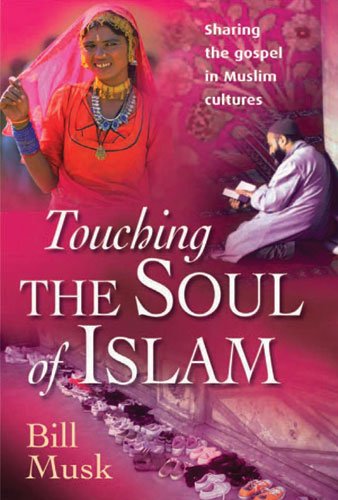

‘A society’s culture is a reflection of its soul’. So begins yet another easy-to-read book from Bill Musk that invites us beyond the theory of the text-books and the prejudices of western liberalism to consider how Muslim people think and live. In Touching the Soul of Islam, Musk dons his ‘cultural anthropologist’ hat to explore Middle Eastern culture. The aim is so to hear the ‘Soul Music’ (the title of the last chapter) of Muslim people that ‘our apostolic mission will be more suitably fulfilled as we learn to express it in ways appropriate to human spirits very different from our own’ (p. 20).
Each chapter takes two themes in tension. ‘Male and female’, ‘Family and individual’ and ‘Honour and shame’ follow ideas common to many writings on non-western cultures, but Musk brings them to life with his story-telling gift and quotations from contemporary literature. Other themes may be less familiar. ‘Hospitality and violence’ and ‘Brotherhood and rivalry’ illuminate different sides of cultures with strong group cohesion. ‘Time and space’ and ‘Language and silence’ explore priorities, relationships and communication. ‘Resignation and manipulation’ considers how people respond to a totally powerful God.
Each chapter considers implications for Christian witness, for Christian minorities, and for converts. I particularly appreciated the use of Middle Eastern cultures to illuminate the Bible. Have you wondered why Abraham did not leave Haran until his father died, or why all of Achan’s family were executed because of one person’s sins? Chapter 3, ‘Family and individual’, offers a convincing explanation. Chapter 5, ‘Hospitality and violence’, brings the parable of Lk. 11:5–8 alive in the context of Middle Eastern hospitality, but also traces themes of violence through the Bible. Chapter 8, ‘Brotherhood and rivalry’ explores NT ideas of brotherhood and their implications for the church. There is much food for thought here.
There is also much to help Christians in their witness. Appreciation of the relationship between Biblical and Islamic themes can help us to introduce Muslims to a Bible that speaks directly to them, and to avoid confusing them with our own explanations.
However, the reader needs to note that Musk is dealing specifically with Middle Eastern culture: while much of the book is also relevant to other Islamic cultures, some is not. I found myself constantly asking whether any given aspect of culture was Islamic or merely Middle Eastern, and what might be the relationship between the two.
Musk does not explore this, but is aware of his limitations (see p. 19). Study questions on each chapter encourage reflection on what might apply to particular Muslims. They also challenge readers to reflect on their own culture, their understanding of Scripture, their spiritual life, and their relationships with Muslims. If you don’t have time to read the whole book, it would be worth just reading these questions: you might then make time for reading the rest!
The bibliography is also worth reading. It ranges from contemporary Arab novels through anthropological and sociological studies to stories of converts and books by Christian missionaries. The index is disappointing until you learn to subtract 2 or 3 from each page reference number.
I hope that this book will be widely read and thought on, and that the whole church of God may pray with Musk (p. 210):
Clothe us in your Spirit, that we, reaching beyond the known and familiar and entering the unique worlds of our fellow men, may bring those who know you not within the clasp of your perfect salvation; to the glory of your holy name. Amen
We need to pray and work for this in more contexts than that of Islam!
Crosslinks, London.