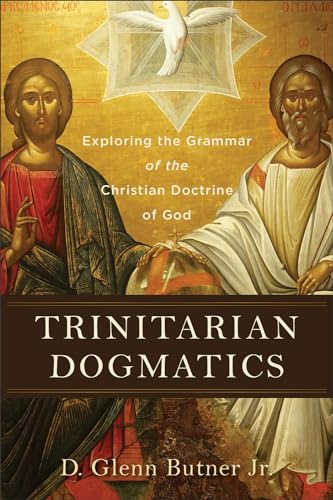
Delving into the mysteries of the Trinity is not a task to be taken lightly. At the very least, such an enterprise would require careful biblical exegesis, deep interaction with key historical sources, and astute deployment of theological reasoning. In Trinitarian Dogmatics, D. Glenn Butner Jr. employs all these qualities while presenting a unique, dialectic approach to the doctrine that begins with logically foundational concepts and progresses into more complex issues.
Butner delves into his investigation by exploring the complementary topics of consubstantiality (ch. 1) and processions and personal properties (ch. 2). Looking to the canonical development of the person of Jesus, Butner notes that Christ’s mediatorial role and reception of worship clearly rise to the point where he is identified with God himself. Investigations of Basil of Caesarea, Thomas Aquinas, and historical Christian-Muslim dialogues further develop the balance of oneness and perceptibility. The topic of processions and personal properties begins with a defense of eternal generation. Origen anchored generation in immutability, implying a distinction between the Father and the Son while preserving unity of nature. Thomas Aquinas further develops divine processions with his doctrine of analogy, buffering generation from becoming a mere act of creation. Following the biblical narrative yields further support that the Son and Spirit have “unique, intimate, ordered, and differentiated relations with the Father” (p. 70).
Chapters 3 and 4 address the topics of simplicity and persons/relations, respectively. Butner surveys four common approaches to divine simplicity (conceptual distinction, virtual distinction, formal distinction, and apophatic). He then moves toward a biblical defense of the doctrine, demonstrating simplicity via scripture’s affirmation of Jesus as God while eschewing divine hierarchy and preserving singularity. Logically, the doctrine remains coherent so long as the relationality of the Godhead avoids introducing compositional distinctions. Moving into the next chapter, Butner sets forth six parameters which must be met for defining divine personhood: rationality, dissimilarity, Christological compatibility, relationality, unity, and uniqueness. Drawing from these categories, he describes a divine person as “a unique subsistence of the singular and rational divine nature that is distinguished from yet inseparably united with the other divine persons by the divine relations” (p. 127).
Butner’s third juxtaposition covers perichoresis (ch. 5) and missions (ch. 6). He investigates three common metaphors for perichoresis: the divine dance, mutual indwelling, and unity of love, consciousness, and will. Bringing Moltmann into the discussion raises more questions regarding the dogmatic function of this doctrine, especially differentiating it from union with Christ. Ultimately, perichoresis differs from union with Christ in the aspects of duration, extent, ontology, and symmetry. Regarding missions, Butner brings Irenaeus into dialogue with 21st century theology to show that the divine missions reveal God through creation in a cataphatic mode. Unlike processions, missions are contingent, non-exhaustive acts of God’s self-revelation and communication. The doctrine of perichoresis grounds salvation itself as a thoroughly trinitarian work.
The final coupling covers inseparable operations (ch. 7) and communion (ch. 8). Butner establishes the biblical warrant for inseparable operations by demonstrating that there is a single divine power operating in a threefold form. To dispel the objection that inseparable operations destroy personal distinctions, Butner argues that the doctrine applies to origin and relation rather than nature or rank. Furthermore, the doctrine of appropriations associates attributes and acts with a particular divine person, bolstering the ability to distinguish divine persons while maintaining a single divine operation. As he draws his investigation to a close, Butner explores three different models of communion: co-ordinate, linear, and incorporative, with each having its distinct benefits. The co-ordinate model encourages prayer and worship that directly addresses each person of the Trinity. The linear model shows how all three persons are united in their work. The incorporative model emphasizes the indwelling presence of the Spirit. All of this shows the fundamental importance of the doctrine of the Trinity, directing the church to worship God in spirit and in truth.
Trinitarian Dogmatics is a staggering accomplishment of dogmatic theology. Butner’s own stated intent was “to write a systematic account of the Trinity that is normed by Scripture and shaped by centuries of polemical debates … to create instruction that benefits the church” (p. 3). Mission accomplished! The breadth and depth of Butner’s scriptural interpretation and historical investigations are truly impressive and will undoubtedly be a resource worth returning to time and again.
Butner’s documentation and eye toward teaching also make this a helpful resource in advanced theological education. Each chapter concludes with an annotated bibliography, several of which include majority world voices. This rich sourcing, in itself, makes Trinitarian Dogmatics a vital resource in Trinitarian theology. The glossary in the back matter is also a welcome addition that will benefit students as they parse through a variety of detailed terminology.
Butner’s proficiency also makes it difficult to find a proper home for this work. His meticulous arguments and broad historical acumen call for a highly learned audience that would potentially lie beyond the stated intent of being “targeted to the seminary and to other graduate-level classrooms” (p. 2). In addition, the interconnected of the various theological loci prevents each chapter from exhaustively addressing its given topic. The reader must carefully trace that topic as it resurfaces throughout the book in order to glean its full import. That being said, such an approach to reading Trinitarian Dogmatics will be well worth the effort. It is a rich resource that will undoubtedly benefit the academy and the church.