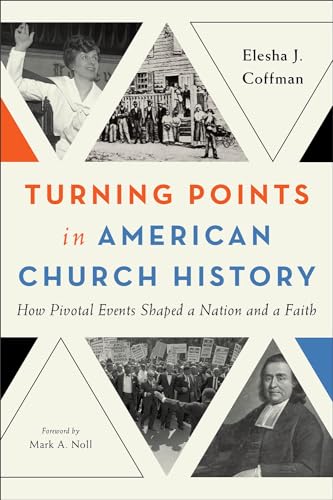
The idea of turning points in the history of the Church is already familiar to readers of Mark Noll’s earlier volume, Turning Points: Decisive Moments in the History of Christianity (Grand Rapids: Baker Academic, 1997), which is now in its fourth edition. Elesha Coffman has taken up this concept (evidently with Mark Noll’s blessing) and utilized it to explain the story of the American Church. The Turning Points format selects thirteen representative themes or events. It lends itself to use in settings as varied as a college, seminary course, or the basis for a series of group studies at home or church. It goes without saying that the effectiveness of this approach hinges on selecting themes that adequately encapsulate developments in the centuries covered.
Coffman, now at Baylor University but earlier at Dubuque Theological Seminary, conceived of this volume as a means of filling a gap in the church history instruction she offered to seminarians in that ecumenical Iowa setting. There Methodists and Presbyterians teach side-by-side, and the student body enfolds students from those churches and others. The volume—as she then conceived it—was intended to supplement other materials used in a semester-long course.
This work has a number of strengths. From the start, Coffman determined that marginalized groups would receive overdue attention in the telling of the American church’s story. Accordingly, from the first theme onward, “The Old World Order Upended”—which unfolds the significance for North America of the cresting of Spain’s international reach in 1588—the author wants the reader to realize that indigenous populations would suffer displacement, epidemic, and decimation whether under Spanish, French, or British jurisdictions. Chapter three, which focuses on the plight of the Christian Indian population in the rebellion known as “King Philip’s War” (1675–1676), carries this theme forward. The obstacles standing in the path of enslaved African Americans even hearing (let alone preaching) the gospel provide the theme of a fifth chapter. The perils faced by African American Christians in the Civil Rights era gain our attention in chapter twelve. The reviewer found this material thought-provoking.
Closely related to the above is Coffman’s focus on Christian minorities who found the hoped-for religious liberty of the new world elusive. Chapter 2 explores the opposition faced in the Massachusetts Bay colony by Roger Williams, opposition necessitating his migration to the eventual Rhode Island. Chapter 6 explores the situation of American Catholics who, in the initial aftermath of the Revolutionary War, enjoyed an era of quasi-independence from Rome only to see post-1800 Irish and continental Catholic immigrants pressing for greater papal deference. A tenth chapter explores the Azusa Street revival of 1906 (quite properly linked to its foreign antecedents), gradually overcoming the initial disdain of more mainstream forms of Christianity to become a recognized “third force” in American and world Christianity.
In quite a different category is the superb chapter 13, “Religion Moves Right.” Read in the context of our current vitriolic political climate, this chapter goes far to explain that evangelicalism’s current over-identification with one political party is something traceable to the Reagan era.
A few weaknesses and omissions should also be noted. One would fully expect that a volume on American Christianity would pay close attention to the era of religious awakening in pre-Revolutionary America. Turning Points does this in its fifth chapter. While Coffman acknowledges that there had been awakenings in earlier decades, these American events are viewed in isolation from earlier events in Wales, Scotland, and central Europe. Though the term “revivalist” is a nineteenth-century term connoting the formulaic reduction of revival to a repeatable method, Coffman follows others in applying this terminology anachronistically to evangelists such as Whitefield. I noted no use made of the important volume by Robert Caldwell III, Theologies of the American Revivalists: From Whitefield to Finney (Downers Grove, IL: InterVarsity Press, 2017).
The sixth chapter, “The Benevolent Empire” is a useful survey of the early nineteenth-century Second Awakening. But as with the treatment of the first awakening, there is inadequate recognition that many of the new enterprises (Bible, Tract, and Missionary Societies) followed patterns provided by longer-established societies in London. A seventh chapter—detailing the destructive consequences of the American debate over slavery upon the churches—concentrates chiefly on Methodism. The latter, while containing a large percentage of the planter class, did not itself provide the barrage of biblical and theological arguments in support of slaveholding. Presbyterians, who did provide that artillery, divided over slavery in 1861 (not, as Coffman has it, 1858). American responsiveness to the call to global evangelization (chapter 9) is treated in connection with the Student Volunteer Movement of the 1880s. This movement is shown to have eventually unraveled in the face of the moral and spiritual confusion that followed the 1914–1918 war. Yet the arguably more foundational initiatives taken by the American Board of Commissioners for Foreign Missions (founded 1810), soon followed by Baptist, Methodist, and Presbyterian initiatives, receive scant attention. The impetus for these had been supplied by William Carey.
Chapter 11, “Science Versus Religion,” helpfully places the Scopes trial of 1925 in a larger context of American population changes (shifting from rural to urban) and in the proportion of citizens completing secondary education. In doing so, it lays the groundwork for an understanding of the ongoing polarization of Christians regarding the teaching of science. It is regrettable that Charles Hodge, an admitted anti-Darwinian, was selected as a representative of Christians suspicious of science (p. 221); Hodge was, after all, the theologian who acknowledged that “Science has in many things taught the church how to understand the Scriptures” (Systematic Theology 1.171).
As far as omissions, Coffman, while repeatedly taking up the themes of marginalization, racism, and discrimination, has shown almost no interest in exploring two turning points that readers of Themelios will consider critical. First is the widely acknowledged resurgence of evangelicalism after WW2. One might suggest that this development is assumed by the book; this reviewer would disagree. Second is the change in American attitudes to the Bible and to Christian doctrine across the twentieth century. Were it not that chapter 9 (on the Student Volunteer Movement) acknowledged that by the 1920s, this movement (along with the YMCA and YWCA) had moved away from earlier commitments to the authority of the Bible and the need for evangelization, we would find almost no discussion in Turning Points of what might be called theological trends. The crisis epitomized by the literary and personal career of the missionary to China, Pearl S. Buck (pp. 189–90), was, in fact, the crisis facing the entire American church. Did the Christian faith require drastic adjustment in order to face changed times? The decline of Christianity in American society over the past century cannot be understood without reference to the markedly different answers given to that question.
Elesha Coffman has provided us with an eminently readable and highly informative approach to the course taken by American Christianity. Its great strength is its concerted attention given to the marginalized and excluded. Designed to attract the widest possible readership, it does not pretend to be a history of evangelicalism. Its single greatest weakness is its avoidance of questions bearing on biblical and theological integrity.